
You ask them to finish coloring a page. Two minutes later, they’re staring out the window. You give them a puzzle. They try it, get frustrated, and walk away. You start reading a book together and by the middle of the page, their mind is already somewhere else.
If any of that sounds familiar — take a breath. This isn’t a problem with your child. They’re 3, 4, or 5 years old.
At this age, a short attention span is completely normal. The young brain is wired to explore, move, and shift focus constantly. It’s not a lack of discipline or a warning sign — it’s healthy development.
The good news is that focus is a skill. And the best way to build it at this age isn’t through rules or instructions. It’s through play.
Why Do Kids Lose Focus So Quickly?
Before we talk solutions, it helps to understand what’s actually going on.
Children between 3 and 6 years old have a very narrow attention window — roughly 5 to 15 minutes for something that genuinely interests them, much less if it doesn’t. That can’t be changed overnight, but it can be stretched gradually with the right activities.
There are three main reasons kids get distracted:
The activity doesn’t have a clear challenge. If it’s too easy or too hard, the brain starts looking for something more stimulating.
Too many things are competing for their attention. Noise, screens, toys in sight — all of it pulls focus away before it has a chance to settle.
They haven’t practiced holding attention yet. Like any skill, it takes repetition. A child who has never been asked to finish something doesn’t yet know how.
The key is choosing activities that are interesting enough to hook them, and short enough that they can actually finish — and feel good about it.
3 Simple Games to Build Concentration
1. Spot the Difference
How to play: Show your child two pictures that look almost identical and ask them to find what’s different. You can use printed sheets, activity books, or even two simple drawings you sketch by hand.
Why it works: To find a difference, a child has to compare both images piece by piece — without skipping anything. That trains sustained visual attention: the ability to look carefully over time, without rushing ahead.
Tip: Start with images that have only 3 obvious differences. As their skill grows, gradually increase the difficulty.
🧩 Looking for physical materials to go alongside this activity? Here are the toys that work best for building visual attention: [Best Toys to Develop Concentration in Children Ages 3 to 6]
2. I Spy
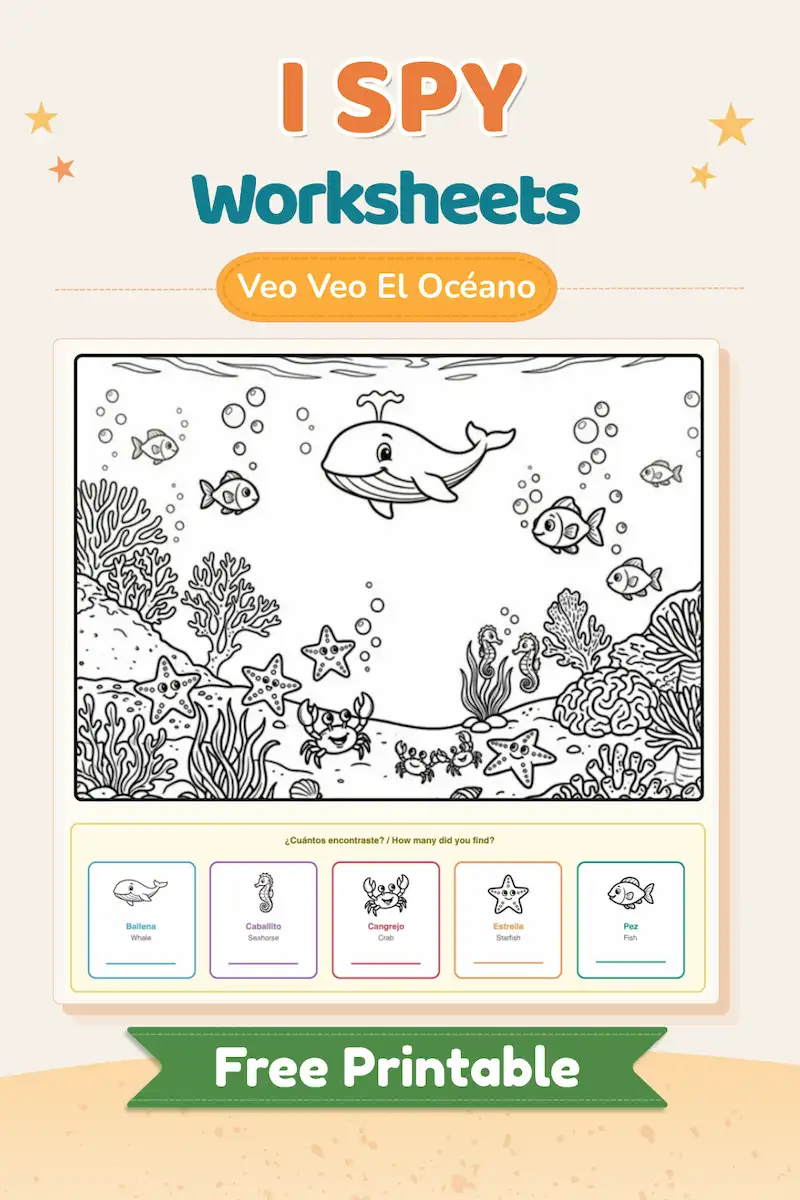
How to play: Show your child a scene full of objects or animals and give them a mission: “Find all the hidden rabbits and count how many there are.” When they finish, they write down or say the number out loud.
Why it works: Active searching is one of the most effective formats for building concentration in young children. There’s a clear goal, a concrete result, and the child is in control of their own process. That combination creates a kind of focused engagement that passive activities simply can’t produce.
It also works beautifully with siblings: the older child looks for harder objects while the younger one finds the simpler ones. Both are focused. Both are engaged.
Tip: If they can’t find something, don’t jump in right away. Wait a moment and ask: “Have you checked this part of the picture yet?” That pause builds frustration tolerance — just as important as focus itself.
3. The 1-Minute Challenge
How to play: Set a 60-second timer and give your child one very specific task: stack 10 blocks, sort tiles by color, or complete one row of a puzzle. The task should be doable in that time. When the timer goes off, stop — whether they finished or not.
Why it works: A visible time limit creates a boundary that a young child’s brain can actually grasp. Instead of “finish this” — which has no defined end — your child knows exactly when it’s over. That reduces anxiety and sharpens focus for that one minute.
With practice, you can gradually increase the time: 1 minute, then 2, then 3. Each small win builds the capacity for longer, sustained attention.
Tip: Celebrate the effort, not just the outcome. “You kept going the whole minute without stopping!” is just as valuable as finishing the task.
A Ready-to-Use Activity for This Afternoon
To help you get started without any prep, we have a free I Spy printable you can download right now and use today.
It’s an observation activity with an animal scene, designed for children ages 3 to 6. All you need is a printer and a pencil. No scissors, no extra materials, no setup.
It comes with three levels of difficulty so each child can work at their own pace — perfect if you have more than one kid at home.
👉 [Download Free: I Spy Animal World — 3 Levels of Difficulty]
Just 5 to 10 Minutes a Day Is Enough
You don’t need to turn this into a lesson. You don’t need a perfect routine starting tomorrow.
You just need one moment a day — 5 or 10 minutes — where your child has something concrete to finish, with you calmly nearby.
That, done consistently, is what shifts attention habits. Slowly, without pressure, one day at a time.
Download the free PDF and start today. 👉 [I Spy Animal World — Free Download]
LogicToy Lab | Bilingual early thinking activities for Spanish-speaking families in the United States. Free resources for children ages 3 to 6.