
It’s 4 in the afternoon. You take away the iPad. And within three minutes, everything falls apart: they’re bored, they’re following you around, they’re crying, or they’ve already grabbed your phone off the counter.
You try a coloring book. They abandon it after two pages. You suggest a puzzle. They last five minutes. You tell them to play with their toys. They look at you like you’re speaking a different language.
If this sounds familiar, here’s the first thing you need to know: this isn’t a discipline problem. It’s a calibration problem.
Screens are engineered by entire teams of designers to hold the attention of a grown adult. Your 4-year-old has no realistic chance of resisting them through willpower alone. And when you remove that stimulus without offering a replacement that their brain can process with the same kind of satisfaction, frustration is inevitable — for them and for you.
The question isn’t how do I take away the screens. The question is what do I put in their place that actually works.
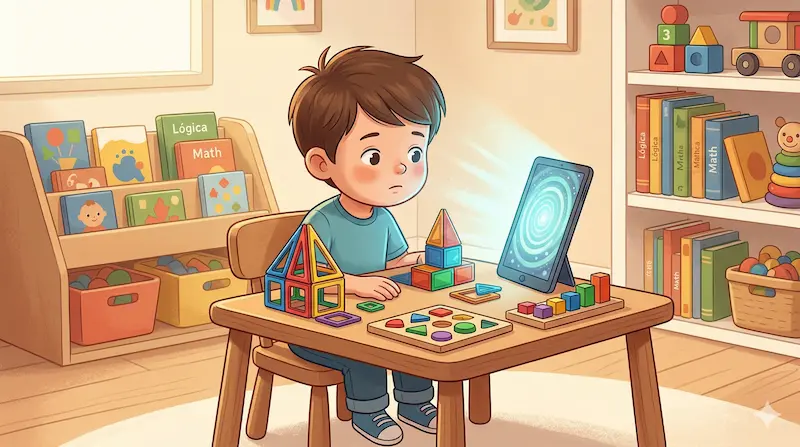
What Screens Give Your Child’s Brain — and Why They’re So Hard to Compete With
To understand what kind of replacement works, you first have to understand what your child is actually getting.
When a child uses a tablet, their brain receives three things in a constant, rapid loop: novelty, immediate feedback, and visual reward. Every tap produces something new. Every action has an instant effect. The colors, sounds, and movement are optimized to keep eyes locked on the screen.
The problem isn’t that this is inherently “bad.” The problem is that it trains a very specific type of attention: reactive, passive, and entirely dependent on external stimulation.
What your child needs for kindergarten — and for life — is the opposite: active attention. The ability to sustain focus on something that doesn’t change by itself. Something that requires them to make decisions. Something that doesn’t pay off immediately, but rewards the effort at the end.
That kind of attention doesn’t develop from watching videos. It develops from searching, finding, and completing.
🧩 Does your child learn better by touching than by looking? If they engage more with physical objects than with paper activities, hands-on toys may be the most effective starting point before moving to worksheets. → [See the guide: Best Toys for Building Concentration in Children Ages 3 to 6]
Why Typical “Educational” Activities Don’t Always Work Either
Here’s the part many parents don’t expect to hear.
Generic coloring books, unstructured activity pages, and toys that don’t present a real challenge don’t train sustained attention either. They’re better than a screen, yes — but if your child abandons them in five minutes, it’s not because they’re restless. It’s because the activity doesn’t have what their brain is looking for: a real problem to solve.
Attention works like a muscle. It needs resistance. It needs something to find, something missing, something that isn’t immediately obvious.
What Kind of Activity Actually Builds Concentration
Activities that genuinely develop sustained attention in children ages 3 to 6 share three characteristics:
1. A clear, bounded goal. Not “draw whatever you want.” But “find the 6 crabs hidden in this scene.” The brain knows exactly what it’s looking for — and that activates focus.
2. Active searching, not passive response. The child has to look, compare, and decide. Not just react to whatever appears on a screen.
3. A real sense of completion. Not a notification, not a victory sound — but the genuine satisfaction of having found something that took effort to find.
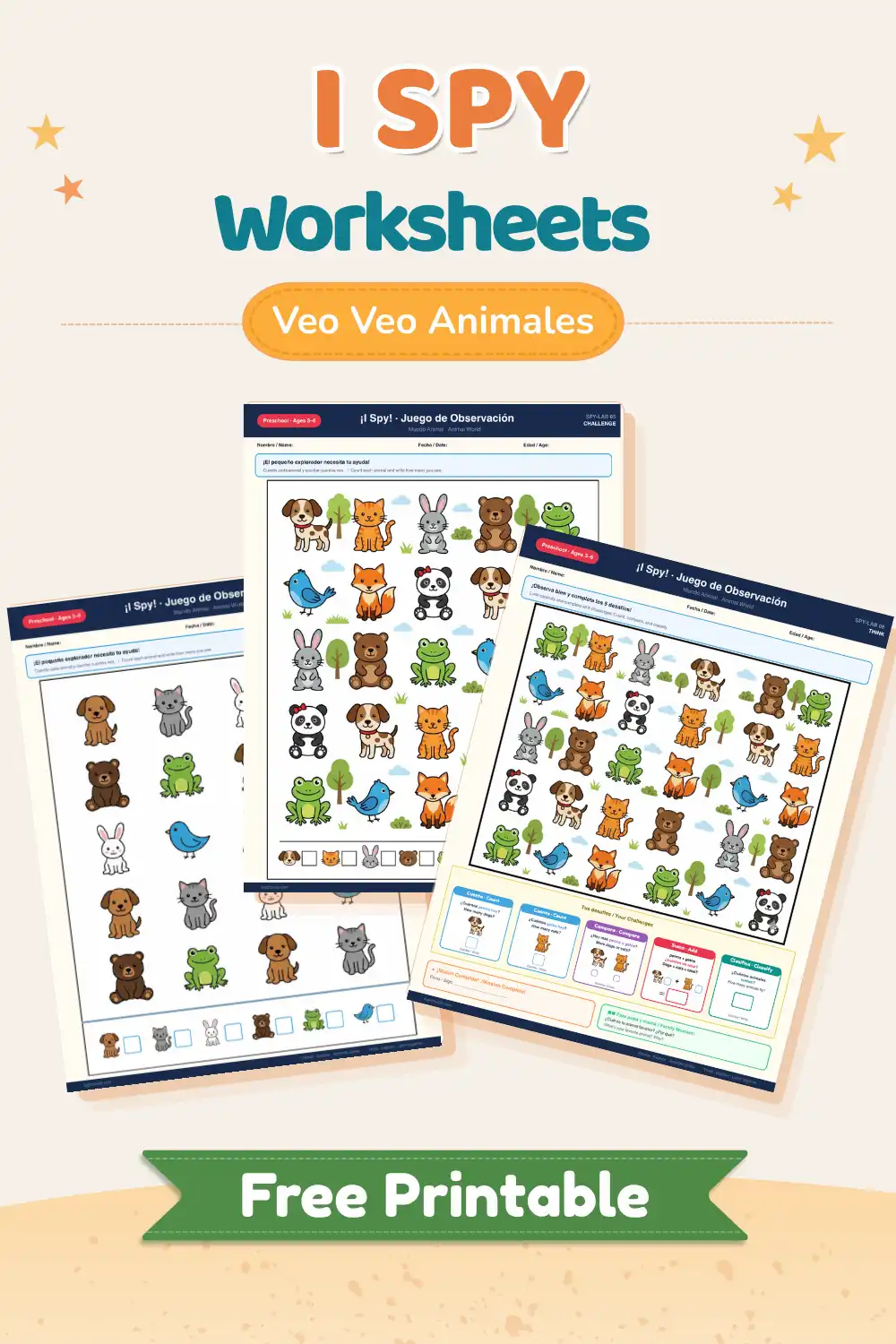
I Spy activities check all three of these boxes. And they work especially well for children who have had heavy screen exposure, because the visual format is rich — colors, details, a full scene to explore — but the child controls the process, not an algorithm.
How to Use an I Spy Activity to Train Attention — Step by Step
The activity itself matters less than how you introduce it. The way you set it up determines whether it lasts 3 minutes or 20.
Before you start: Don’t say “let’s do an activity.” Say: “I have something really hard. Let’s see if you can find it.” A challenge activates attention far more effectively than an instruction.
During: If they can’t find something, don’t jump in. Wait. Let them search. If after a full minute they’re still stuck, offer a location hint — not the answer: “It’s near the water” rather than “it’s in that corner.”
When they find something: Don’t just say “good job.” Ask: “How did you find it? What did you notice first?” Making them verbalize the process consolidates the attention skill — and prepares them to do it independently next time.
When they finish: Let them count how many they found. That final count is the cognitive closure their brain needs to register the activity as complete and satisfying.
An Activity You Can Use This Afternoon
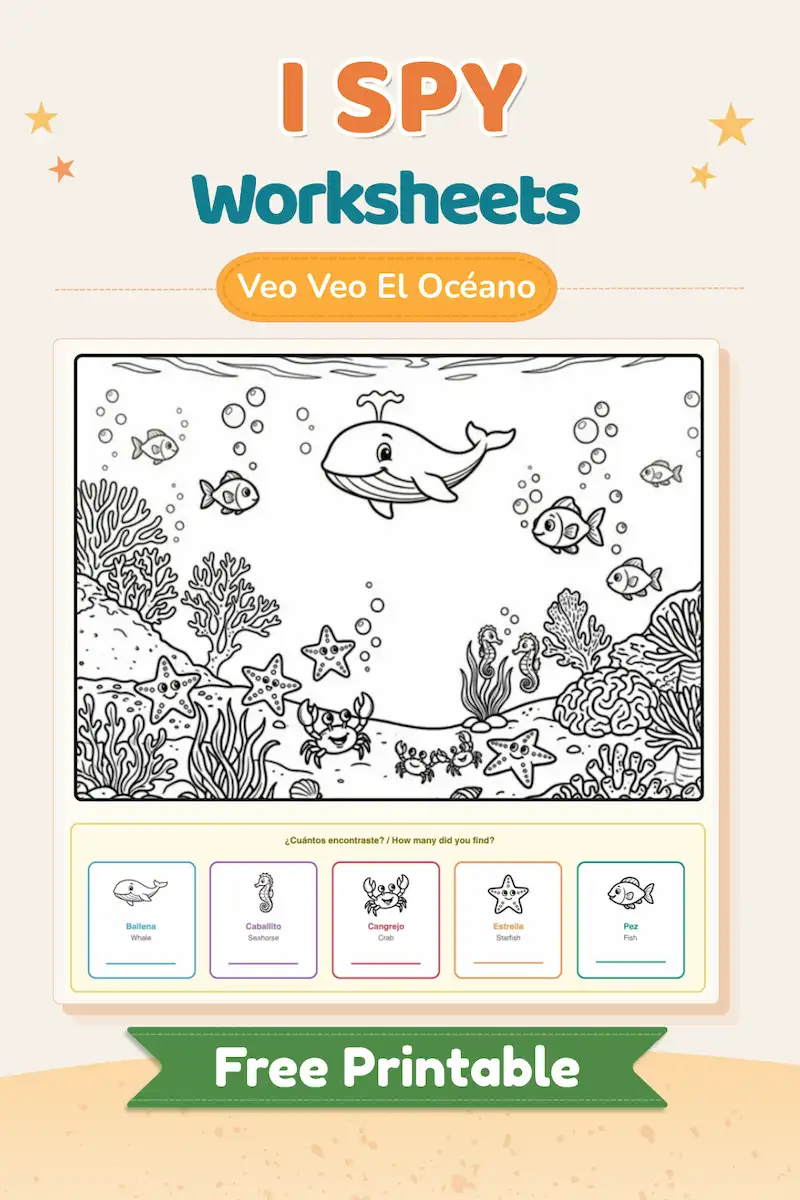
We have a free I Spy ocean scene worksheet designed specifically for children ages 3 to 6. It’s not a grid of objects — it’s a full illustrated scene with visual depth, where the elements are embedded in the environment rather than lined up in rows.
That distinction matters. A real scene demands more attention than a grid. The child has to explore the entire image, not just scan left to right down a list.
The sheet includes a narrative mission (“help the octopus find its friends”), a family moment prompt for a parent to participate, and a mission complete badge at the end.
👉 Download free: I Spy Ocean — Concentration Activity for Preschool
When a Worksheet Isn’t Enough: When to Think About Toys
For some children — especially those who have had months of heavy screen use — a printable worksheet is a good first step, but it’s not enough on its own to rebuild sustained attention.
These children need physical objects: something they can touch, move, and rearrange. The tactile component activates a different kind of brain processing than visual-only tasks, and for children with very scattered attention, that combination tends to be significantly more effective.
If you notice your child abandoning worksheets quickly even when the topic interests them — or if they need you present constantly to avoid getting distracted — that’s a signal worth paying attention to.
👉 [Read: Best Toys for Building Concentration in Children Ages 3 to 6]
One Thing You Can Do Today
You don’t need to eliminate screens overnight. You don’t need a perfect routine starting tomorrow.
You just need to create one moment each day — 15 minutes — where the stimulus your child receives is one they control, not one that controls them.
An I Spy sheet on the kitchen table. You nearby, not hovering. Them searching.
That, repeated consistently, is what actually moves the needle.
👉 Download free: I Spy Ocean — Start today
LogicToy Lab | Bilingual early thinking activities for Spanish-speaking families in the United States. Free resources for children ages 3 to 6. No sign-up required.