
There’s an important difference between a toy that entertains and a toy that builds concentration. The first one keeps a child busy. The second one requires them to sustain focus, make decisions, and finish what they started.
For children ages 3 to 6, that distinction matters a great deal. These are the years when attention habits form — the habits that will follow them into kindergarten and beyond.
This isn’t a generic list. Every toy here is included because it solves a specific attention problem — and we explain exactly which one.
👉 If your child struggles to stay focused without a screen, you might also want to read: [Can’t Your Child Go Without Screens? Here’s What Their Brain Actually Needs]
What Makes a Toy Actually Build Concentration
Before getting into the list, here’s a quick framework for evaluating any toy on your own:
A toy builds concentration when it has a problem to solve, immediate feedback (the child knows whether they got it right without asking a parent), and progressive difficulty (it’s not equally easy the tenth time as the first).
What doesn’t work: toys with too many pieces and no clear goal, open-ended creative sets for children under 4 (without structure, attention has nowhere to anchor), and toys that do everything on their own with the press of a button.
The Toys
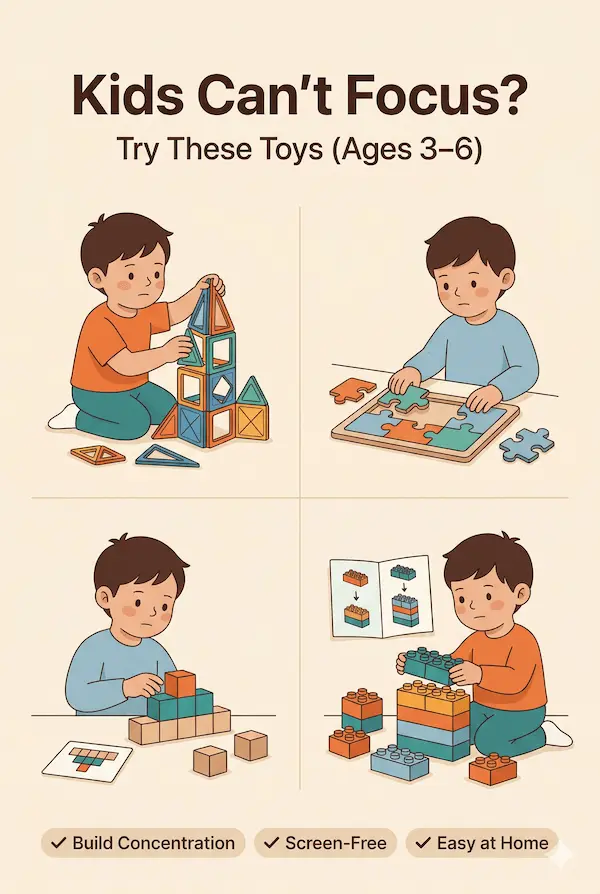
Magnetic Tiles — Ages 3 to 5
The problem they solve: The child who can’t stay still at a table activity for more than two minutes.
Magnetic tiles (like Magna-Tiles or PicassoTiles) work because they combine physical construction with visual logic. Every piece a child places has an immediate, tangible result — the tower holds or it falls, the pattern fits or it doesn’t. That constant feedback keeps the brain engaged without needing a screen.
For 3-year-olds, the simple act of building and knocking down already trains attention. For children ages 4 to 5, you can introduce specific challenges: “build something using only triangles” or “copy this design.” A directed challenge can extend a 5-minute session to 20.
With siblings: Magnetic tiles are one of the few toys where two children of very different ages can play together without conflict. The 3-year-old builds freely; the 5-year-old copies a design or creates a challenge for the younger one to figure out. One set, two levels of concentration active at the same time.
What to know before buying: Cheaper sets have weak magnets that frustrate children because the pieces won’t hold together. It’s worth investing in a brand with solid magnetic quality from the start.
Single-Player Logic Games (SmartGames Junior) — Ages 4 to 6
The problem they solve: The child who starts activities but never finishes them.
SmartGames has a junior line of single-player puzzles with progressive difficulty levels printed on cards. The child draws a card, looks at the challenge, and has to figure out how to place the pieces so they fit exactly.
What makes this format unique is that the child can check their own answer without asking a parent — if the pieces don’t fit, the challenge isn’t solved. That autonomy reduces dependence on adult validation and builds frustration tolerance, which is an essential component of sustained concentration.
Start with the easiest level even if your child seems ready for more. The confidence built on early success is what makes them want to continue.
With siblings: Each child can work on their own card at their own level, quietly, at the same table. No turns, no waiting, no conflict. For families with two or three children, this is one of the most practical toys for creating a parallel concentration moment without the adult having to mediate.
Wooden Blocks with Challenge Cards — Ages 3 to 6
The problem they solve: The child who plays with blocks but never builds anything with intention.
Wooden blocks alone are open-ended material — excellent for creativity, but not necessarily for training attention. The difference comes from adding challenge cards with designs to copy. When a child has a specific model to reproduce, the activity shifts from free exploration to a problem with a solution.
Sets like Melissa & Doug blocks with included cards — or simply printing reference designs on paper — transform blocks into a real concentration tool.
This format works especially well for multi-sibling families: the older child copies a complex design, the younger one copies a simpler one, and both are at the same table using the same materials.
Step-by-Step Construction Sets (LEGO Duplo) — Ages 4 to 6
The problem they solve: The child who loses focus the moment a task has more than one step.
Following visual instructions step by step is a skill that gets trained, not one children are born with. LEGO Duplo sets with a building guide require a child to read an image, find the right pieces, place them in order, and move on to the next step — all before seeing the finished result.
It’s one of the most complete concentration activities available because it combines visual attention, working memory, and impulse control (not skipping steps to get to the end faster).
For 4-year-olds: start with sets of 20 to 30 pieces. For children ages 5 to 6: sets of 50 to 80 pieces are the ideal range before moving on to classic LEGO.
With siblings: The older child follows the building instructions while the younger one has the job of finding and handing over the pieces needed at each step. The older child practices sequential concentration; the younger one practices directed attention and shape and color vocabulary. Both are focused. Both are contributing.
A Built-In Advantage for Multi-Sibling Families
If you have two or more children at home, these toys carry an additional value that goes beyond individual concentration.
When an older sibling explains to a younger one how a challenge works, or when both children work toward a shared goal using the same set of blocks, they’re practicing something no worksheet can teach: communication, patience, and cooperative learning.
Every toy on this list works in solo mode. But with small adjustments in how you introduce them, they also work as two-child activities — where each child contributes at their own level without anyone having to wait for the other.
👉 To see exactly how to structure those dynamics: [How to Teach Patterns to Two Kids of Different Ages at the Same Time]
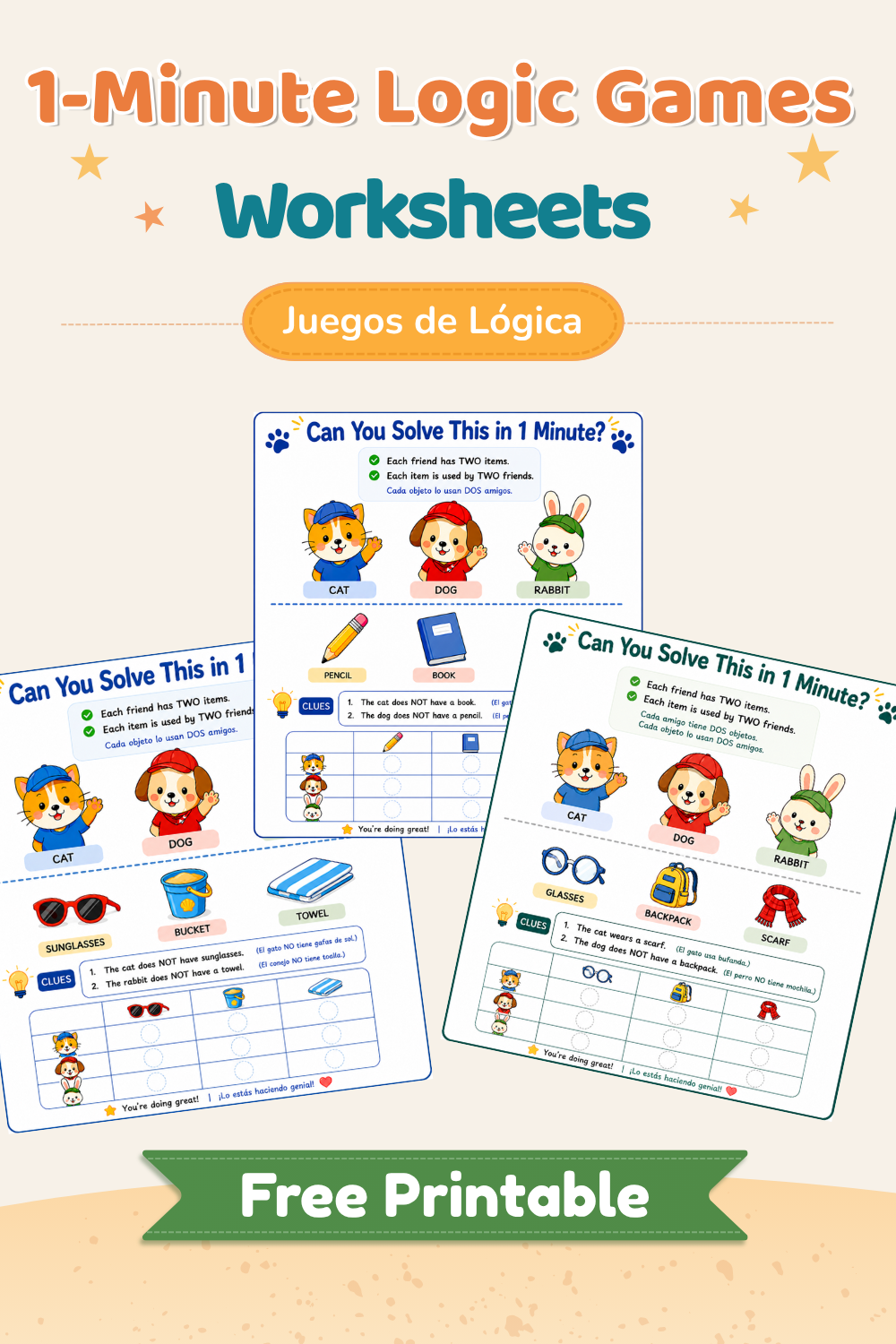
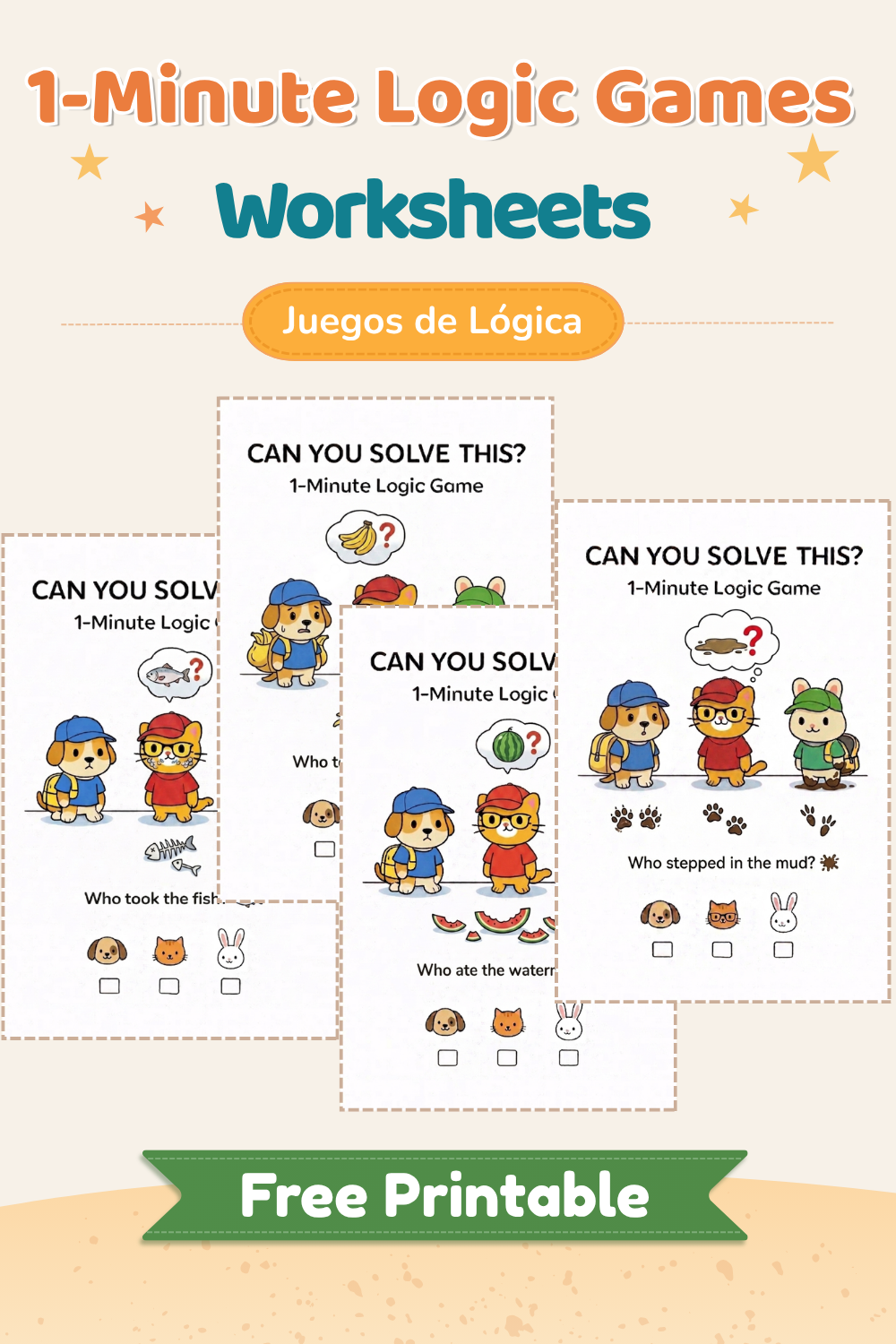
Reinforce with Printable Worksheets
Toys build the capacity for attention. Printable worksheets consolidate it — they’re the moment where a child demonstrates on paper what they’ve already processed with their hands.
If you use any of these toys regularly, adding 10 minutes of printable activity at the end of the session reinforces the learning in a meaningful way.
👉 Download free: Concentration Activity for Preschool
LogicToy Lab | Bilingual early thinking activities for Spanish-speaking families in the United States. Free resources for children ages 3 to 6. No sign-up required.