
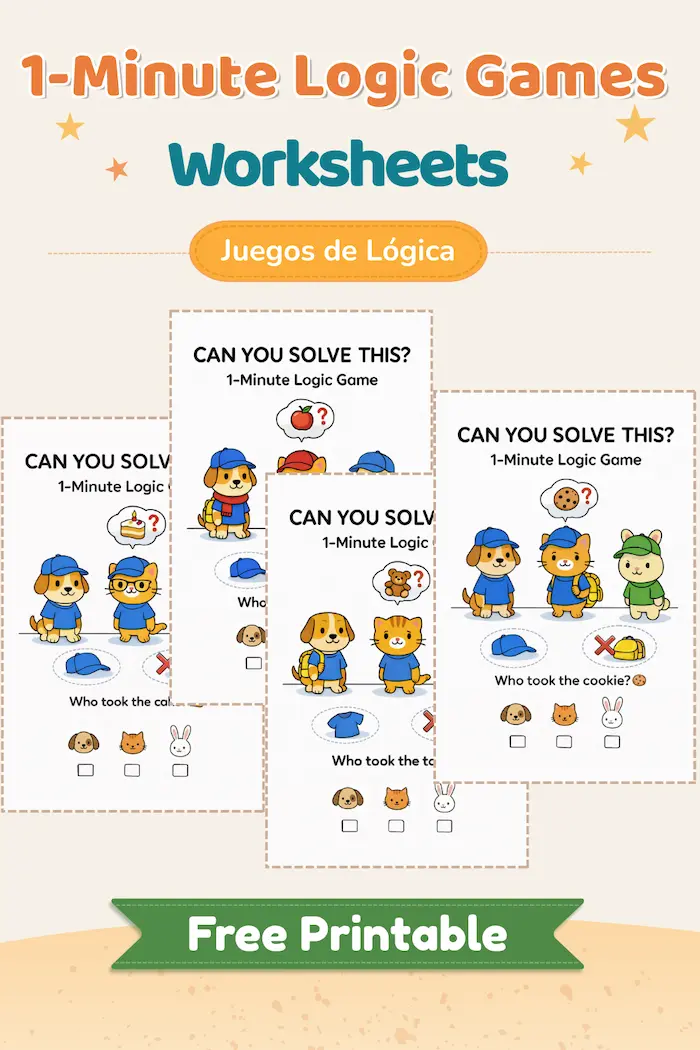
Free Printable Download
Free
Spanish & English
What’s Inside This Collection
4 detective-style logic games, all at the same difficulty level
Bilingual instructions on every sheet (English + Spanish)
3 recurring characters: Dog, Cat, and Rabbit — easy for young children to recognize
Mixed clue system: one positive clue (what the suspect HAS) + one negative clue (what they DON’T have)
Sibling mode: one child reads the clues, the other solves the mystery
Print-ready US Letter format — straight from download to activity
Optimizado para: hogar o aula • Calidad Profesional
Inside this Worksheet
Each sheet follows the same format: look at the three characters, read the left clue (what the suspect HAS) and the right clue with an X (what the suspect does NOT have), then circle the only character who meets both conditions at the same time.
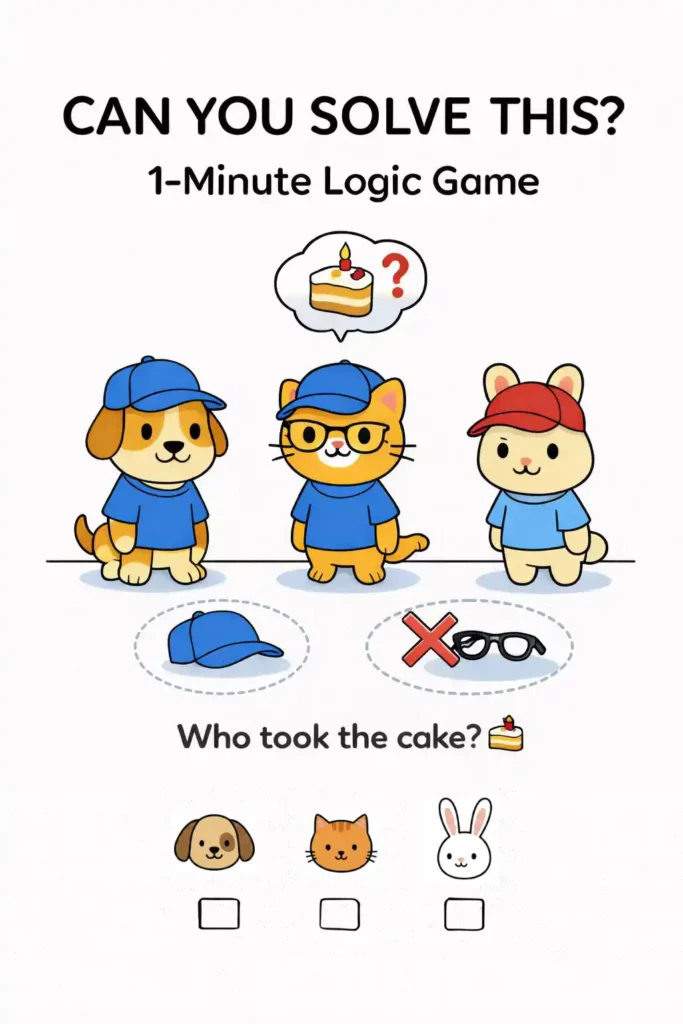
LD-09 · Who Took the Cake? 🎂 — Ages 3–6
Three characters: Dog with a blue cap and blue shirt, Cat with a blue cap and black glasses, and Rabbit with a red cap and blue shirt.
Left clue (HAS): blue cap. Right clue with X (does NOT have): black glasses ❌.
What it builds: reading two different types of clues, verifying a positive and negative condition simultaneously, mixed logical reasoning.
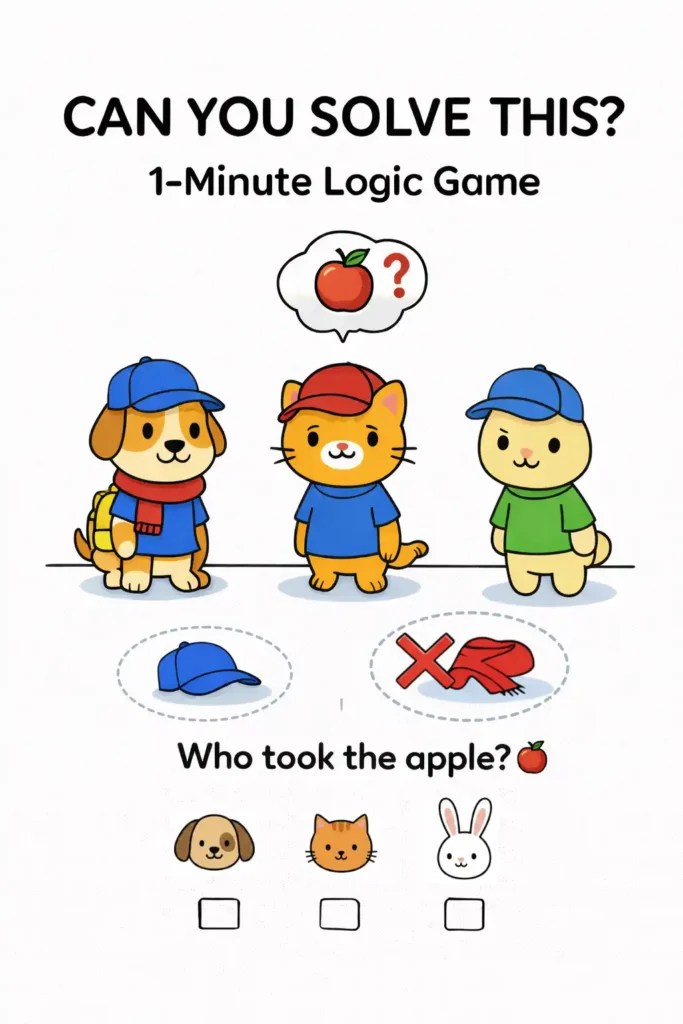
LD-10 · Who Took the Apple? 🍎 — Ages 3–6
Three characters with different caps and accessories: Dog with a blue cap and red scarf, Cat with a red cap and no scarf, Rabbit with a blue cap and no scarf.
Left clue (HAS): blue cap. Right clue with X (does NOT have): red scarf ❌.
What it builds: attention to detail, ruling out based on the negative condition after confirming the positive one, logical flexibility.
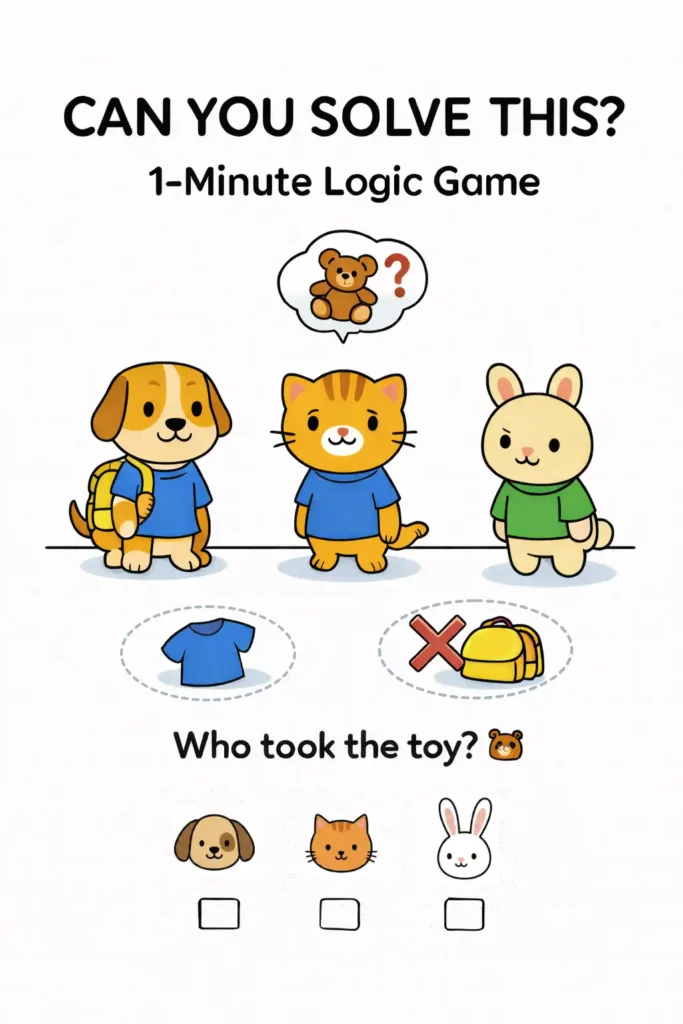
LD-11 · Who Took the Toy? 🧸 — Ages 3–6
Three characters: Dog with a blue shirt and yellow backpack, Cat with a blue shirt and no backpack, Rabbit with a green shirt and no backpack.
Left clue (HAS): blue shirt. Right clue with X (does NOT have): yellow backpack ❌.
What it builds: full-figure visual exploration, verifying the absence of an accessory, mixed-clue reasoning.
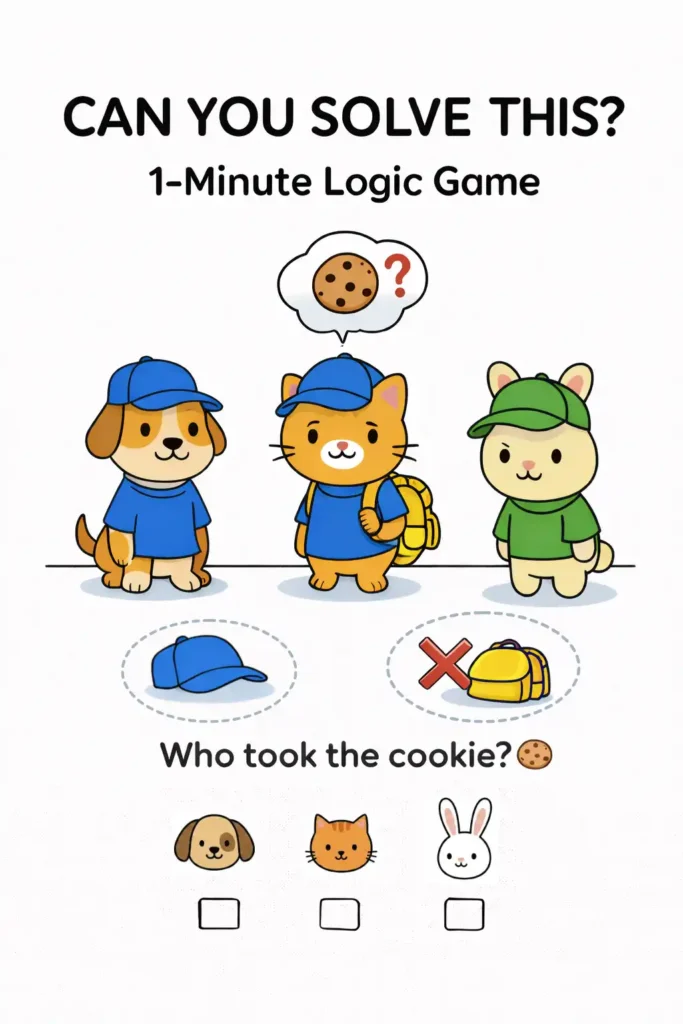
LD-12 · Who Took the Cookie? 🍪 — Ages 3–6
Three characters: Dog with a blue cap and no backpack, Cat with a blue cap and a yellow backpack, Rabbit with a green cap and no backpack.
Left clue (HAS): blue cap. Right clue with X (does NOT have): yellow backpack ❌.
What it builds: sequential reasoning, mandatory application of both clues, advanced logical thinking for preschool.
What Are Mixed Clues — and Why Do They Matter?
In earlier sheets in this series, all clues were the same type: either all positive (the suspect HAS these features) or all negative (the suspect does NOT have these features).
This collection raises the bar: each mystery uses two different types of clues at the same time.
- The left clue (no X) tells you something the suspect HAS.
- The right clue (with X) tells you something the suspect does NOT have.
The child has to find the one character who satisfies both conditions at once — they have the first feature and they don’t have the second.
This requires a more flexible kind of thinking: holding two rules of different types in mind and applying them at the same time. It’s one of the most important steps toward formal logical reasoning — and it’s achievable for children as young as 3 with the right setup.
👉 [Read the full guide: How to Develop Logical Thinking in Preschoolers]
Built for Siblings — Not Just One Child
Every sheet includes a sibling learning section at the bottom of the page.
A natural way to use it: the younger sibling points out and names the accessories they see on each character. The older sibling listens, applies both clues — first confirming who has the positive feature, then ruling out whoever also has the negative one — and reaches the answer.
This cooperative format builds something no solo activity can: the ability to communicate observations so that someone else can reason with them. It’s logic and communication at the same time.
Two kids, one sheet, both contributing. Nobody waits. Nobody gets bored.
👉 [How to Use Learning Activities with Siblings of Different Ages]
How to Use This Worksheet at Home
One tip that makes a real difference: If your child circles an answer after looking at only one clue, ask: “Did you check the other clue too? Does that character pass both?” The habit of always applying both conditions — not just the easier one to spot — is exactly what this collection is designed to build.
🧸 Want to reinforce this kind of thinking with physical toys? These are the ones that work best for building logical reasoning and concentration: Best Toys for Building Concentration in Children Ages 3 to 6
Frequently Asked Questions
Is this collection completely free?
Yes, all 4 worksheets are free. No signup required.
What do I need to print this?
Standard printer + US Letter paper (8.5×11).
Can I use these in my classroom?
Yes,for personal or educational use.
What’s Next?
That’s a great sign — they’re ready for more complex mysteries. The next levels in this series include: