
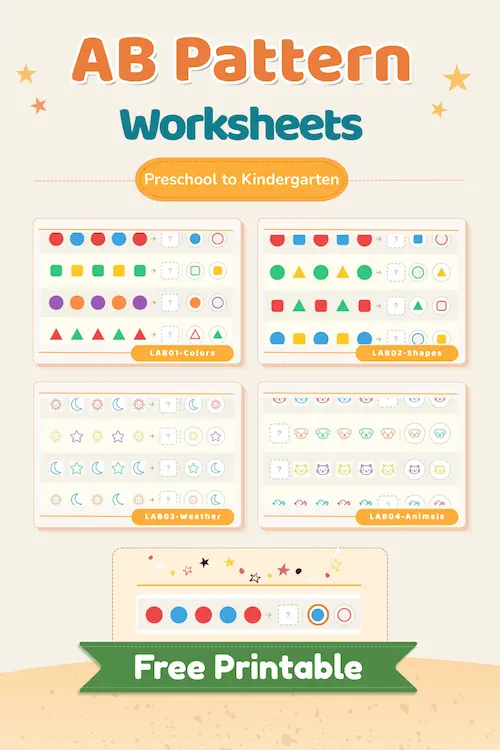

Free Printable Download
Free
Spanish & English
What’s Inside This Collection
4 AB pattern worksheets with progressive difficulty
Bilingual instructions on every sheet (English + Spanish)
Answer guide for parents included
Sibling learning mode built into each worksheet
Extra Challenge on every page for kids who finish early
Print-ready US Letter format — straight from download to activity
Perfect for home learning, classrooms, homeschool programs
Inside this Worksheet
Each sheet follows the same format: look at the sequence, identify the rule, and circle the correct answer. Simple enough for a 3-year-old to understand — with enough variation across levels to keep a 6-year-old engaged.
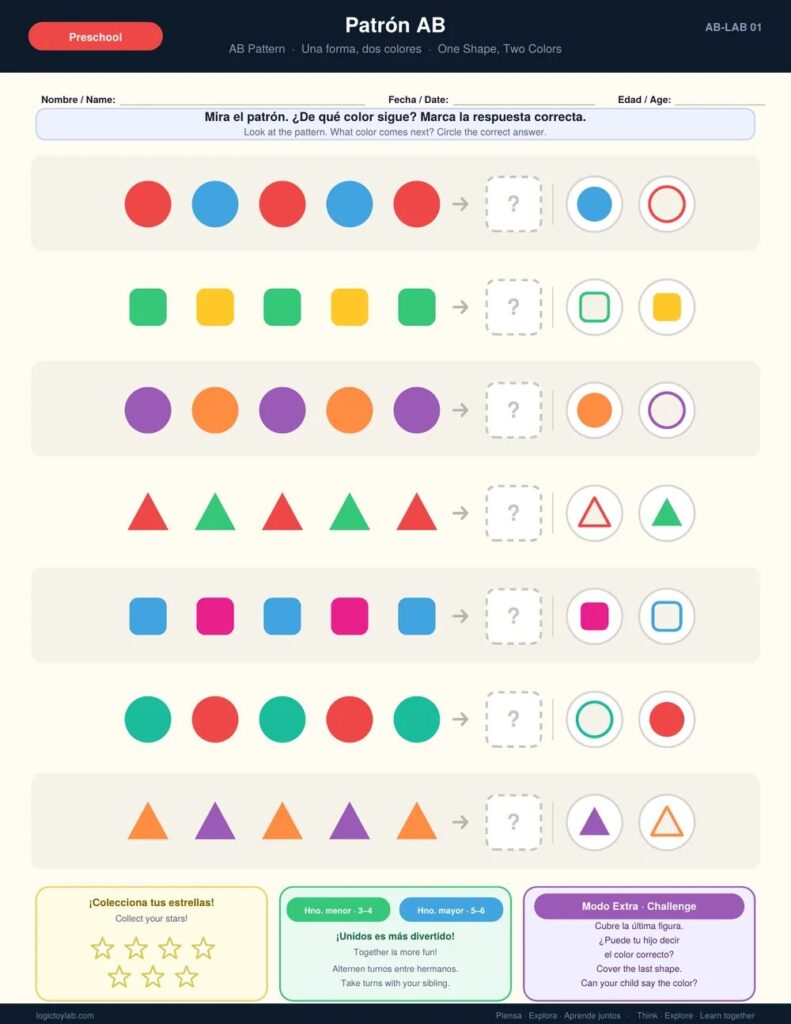
AB-LAB 01 · One Shape, Two Colors — Ages 3–4
The entry point for children who are just beginning to notice that things can repeat.
Seven sequences using a single familiar shape in two alternating colors. The child’s job is to look at what’s happening and circle which color comes next. No cutting, no writing — just observation and decision-making.
This is intentionally straightforward. At this stage, success and confidence matter more than challenge.
What it develops: color recognition, basic sequence awareness, visual attention.
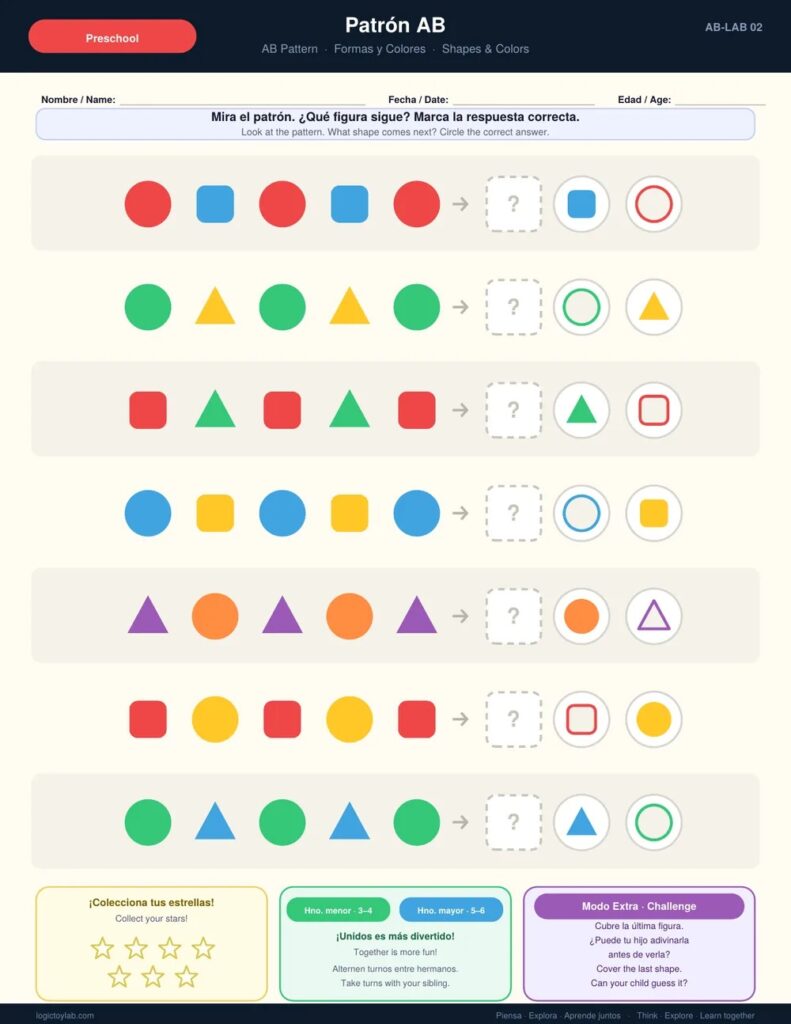
AB-LAB 02 · Shapes and Colors — Ages 3–5
One step up: now both the shape and the color alternate, which means the child has to track two variables at once.
Seven sequences mixing different geometric shapes and colors. The child circles the correct shape that continues the pattern.
What it develops: multi-variable pattern tracking, shape recognition, sustained focus.
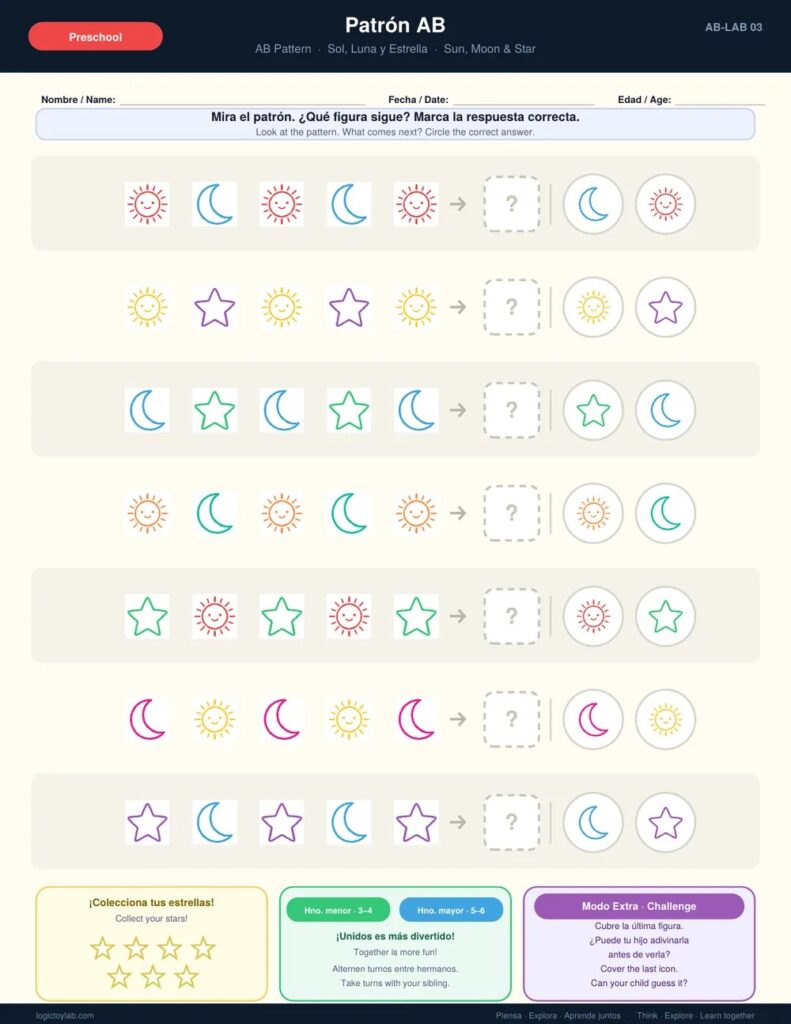
AB-LAB 03 · Sun, Moon and Star — Ages 4–5
Same structure, new visual vocabulary. This sheet uses thematic icons — sun, moon, and star — which introduces a layer of meaning alongside the logic.
The icons vary in both type and color across the seven rows, making this the most visually rich sheet in the collection. Children who have worked through LAB 01 and 02 will notice they’re applying the same skill in a new context — which is exactly how pattern thinking generalizes.
What it develops: icon recognition, pattern transfer across contexts, predictive thinking.
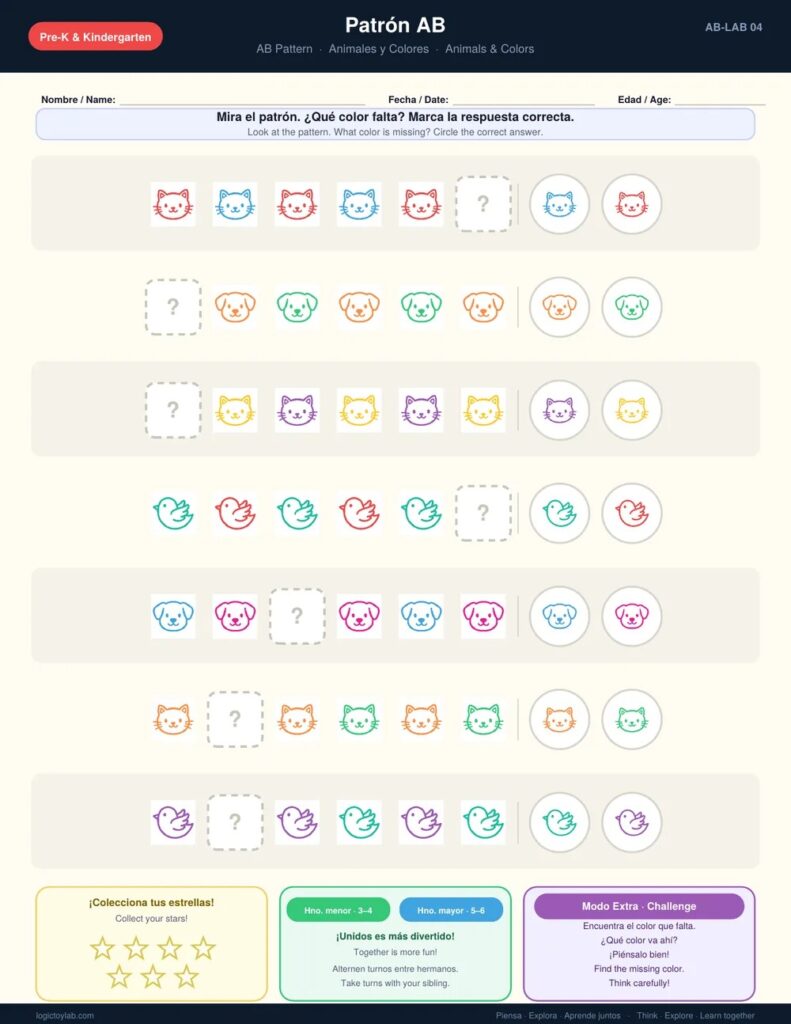
AB-LAB 04 · Animals and Colors — Pre-K & Kindergarten, Ages 4–6
The most demanding sheet in the series. Animal icons (cat, dog, bird) appear in sequences where the missing piece can be at the beginning, middle, or end of the row — not just at the end like in the previous sheets.
This shift requires the child to analyze the full sequence before answering, rather than simply extending it forward. It’s a meaningful jump in cognitive demand and a solid preparation for kindergarten-level pattern work.
What it develops: full-sequence analysis, positional reasoning, logical inference.
What Is an AB Pattern — and Why Does It Matter?
An AB pattern is the simplest repeating sequence a child can learn: two elements that alternate in a predictable rule — red, blue, red, blue / circle, square, circle, square.
It sounds simple. But for a 3 or 4-year-old, recognizing that something follows a rule is a major cognitive leap. It’s the earliest form of logical thinking — and research in early childhood education consistently identifies pattern recognition as one of the strongest predictors of later math ability.
Before children can add, subtract, or sort, they need to understand that the world can be structured and predictable. AB patterns are where that understanding begins.
👉 [Read the full guide: Why Some Children Struggle with Patterns — and What Actually Helps]
Parent Tip:
f your child makes a mistake, avoid giving them the answer right away. Instead, ask: “Does this follow the same pattern as above?” to help them develop self-correction skills.
Built for Siblings — Not Just One Child
Every worksheet in this collection includes a sibling learning section at the bottom:
The Extra Challenge on each sheet asks the child to cover the last icon and predict what it would be before revealing it. This small shift — from recognizing to predicting — is one of the most effective ways to deepen pattern understanding.
Two children, one worksheet, two different levels of engagement. No one waits. No one gets left behind.
👉 [How to Use Learning Activities with Siblings of Different Ages]
How to Use This Worksheet at Home
One tip that makes a real difference: When your child circles the wrong answer, don’t correct immediately. Ask: “Does that match what’s happening in the rest of the row?” The moment they self-correct is worth more than ten right answers given to them.
🧸 Want to take the learning further? The right hands-on toy can reinforce what these worksheets build — and keep the momentum going between sessions. See our full guide: Best Pattern Toys for Kids Ages 3–6 — Educational and Actually Fun
Frequently Asked Questions
Is this collection completely free?
Yes — all 4 worksheets are free to download with no account or email required.
What do I need to print this?
A standard printer and US Letter paper (8.5×11). Color printing is recommended for the best visual experience, but the sheets are also readable in grayscale.
Can I use these in my classroom?
Yes, for personal and classroom educational use. Commercial redistribution is not permitted.
My child finished all 4 sheets easily. What’s next?
That’s a great sign — they’re ready for more complex pattern types. The next steps in the LAB series include: