
I stood at the edge of the sandbox, one sneaker hovering in the air, not sure if I was about to go in or run away.
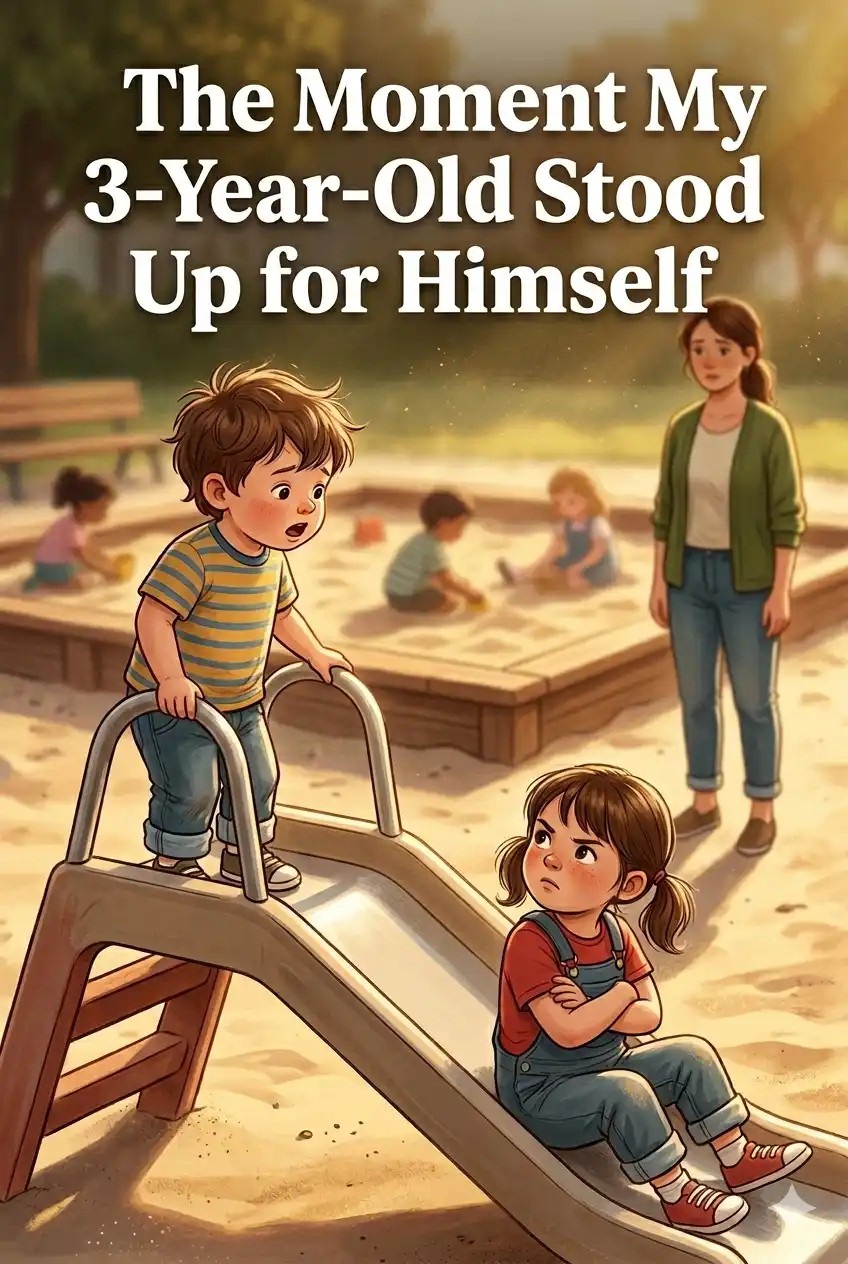
My 3-year-old was frozen at the top of the slide. An older boy—maybe five?—had his arms out, blocking the bottom and shouting, “You can’t come down, this is mine!”
My son’s eyes were wide. His little fists were clenched. He wasn’t crying. He was just holding perfectly still, like a rabbit who hopes the fox won’t see him.
And there I was, heart thumping, wanting to march over and say something. But also wanting him to learn to say something himself.
That tension—between rescuing and waiting—is what I think about every time playground politics show up in our day.
The moment I realized flying in wasn’t the answer
I almost did it. I almost walked over and said, “Hey, it’s his turn too.”
But then I noticed something. My son’s face wasn’t scared in a bad way. It was thinking. He was assessing. He was quiet, but he hadn’t looked at me for help yet.
I held my breath. Six seconds passed. Then seven.
He leaned forward and said, in a voice that was small but clear: “I want to slide now. You can go after.”
The older boy stepped aside. My son went down. Nobody cried. Nobody got in trouble.
And I realized: the hardest part of teaching a kid to stand up for themselves is letting them try it before you step in.
What 3-year-olds understand about conflict
When I talked to a friend about it later, she laughed and said, “Oh please, that was luck. Next time he’ll just shove the kid.”
And she’s right—sometimes he does. Sometimes he shoves or freezes or just stands there crying until I swoop in. But I’ve started noticing something important.
A three-year-old isn’t powerless. They just don’t have the practice. When my son froze on the slide, his brain wasn’t broken. His language was just slower than his fear.
Preschoolers freeze not because they can’t learn self-advocacy—but because their feelings move faster than their words.
The same child who melts down over a toy at home can find a surprising calm when Mom stays quiet and waits.
The thing nobody tells you about helicopter parenting
I’ve been called a helicopter mom exactly one time face-to-face, and hundreds of times inside my own head.
Sometimes I hover because I’m anxious. Other times I hover because I just want my child to stop struggling for five minutes. But here’s what I didn’t understand until my son started preschool.
Flying in doesn’t always teach safety. Sometimes it teaches dependence.
When I say “let him handle it,” it feels awful. Like I’m abandoning him. But when I’ve tried just standing close without speaking—just being a silent witness—he often manages better than I expect.
The signs a child is ready to stand up for themselves
At three, they’re not going to argue legal pleas. But watch your child on the playground, and you’ll see tiny pockets of readiness.
- They look at the other child, then glance at you, but don’t cry yet.
- They say “no” quietly, then look to see if you’ll back it up.
- They start to say something, stop, and then try again a moment later.
These are the moments I’m trying to catch myself. Instead of rushing in, I try to give them three extra seconds to find their own words.
What looked like an inability to stand up for himself was often just a lag between feeling and speaking—a lag I could fill with my own voice, or let him fill with his.
What helps our family instead
I can’t say we’ve got it figured out. Some days, my son shrieks at a kid who is just walking past. Other days, he lets a child take his coat and walks away silently.
But one thing shifted our perspective a lot. A local librarian told me about a book called Sharing Time / Momento de compartir. It’s not a curriculum—it’s just a little paperback that gives kids phrases to say in hard moments.
I started reading it with my son before park trips. Not formally, just lying on the floor, flipping through, practicing lines like “I’m still playing with that” and “You can use it when I’m done.”
He calls it his “brave book.” He brings it to the car sometimes. It worked not because it’s a magic cure, but because it gave his brain a script to follow when anxiety shut down his natural words.
And me? It reminded me that my job isn’t to give him my script instead. It’s to hand him a toolbox and let him pick the tool.
The days it doesn’t work
Last week, we tried to practice on the swings. An older girl took his turn and said something rude.
My son just looked at me, started crying, and buried his face in my knees.
I could have recited every phrase we practiced. But it wasn’t the moment. So I just held his head against my stomach and said, “That was hard. Let’s sit and wait.”
And that was the whole lesson that day: some days, standing up for yourself looks like knowing when it’s okay to lean on someone who loves you.
What I keep telling myself
Teaching your child to stand up for themselves isn’t about me moving out of the way. It‘s about making sure they know I‘m behind them, not above them.
Playground politics aren’t going away. Next week there will be new kids, new sharing problems, new moments where he freezes or I jump in too fast. But I’m trying to trust that practice—even when it feels scary—is how he grows.
And honestly? Some of the brave things he says now, I never could have taught him. They came out because I got quiet long enough to hear them.
So I’ll stay close. And I’ll bite my tongue. And I’ll try to believe that my two feet planted nearby are better than my body swooping in.
Most days, anyway.