
Inside this Worksheet
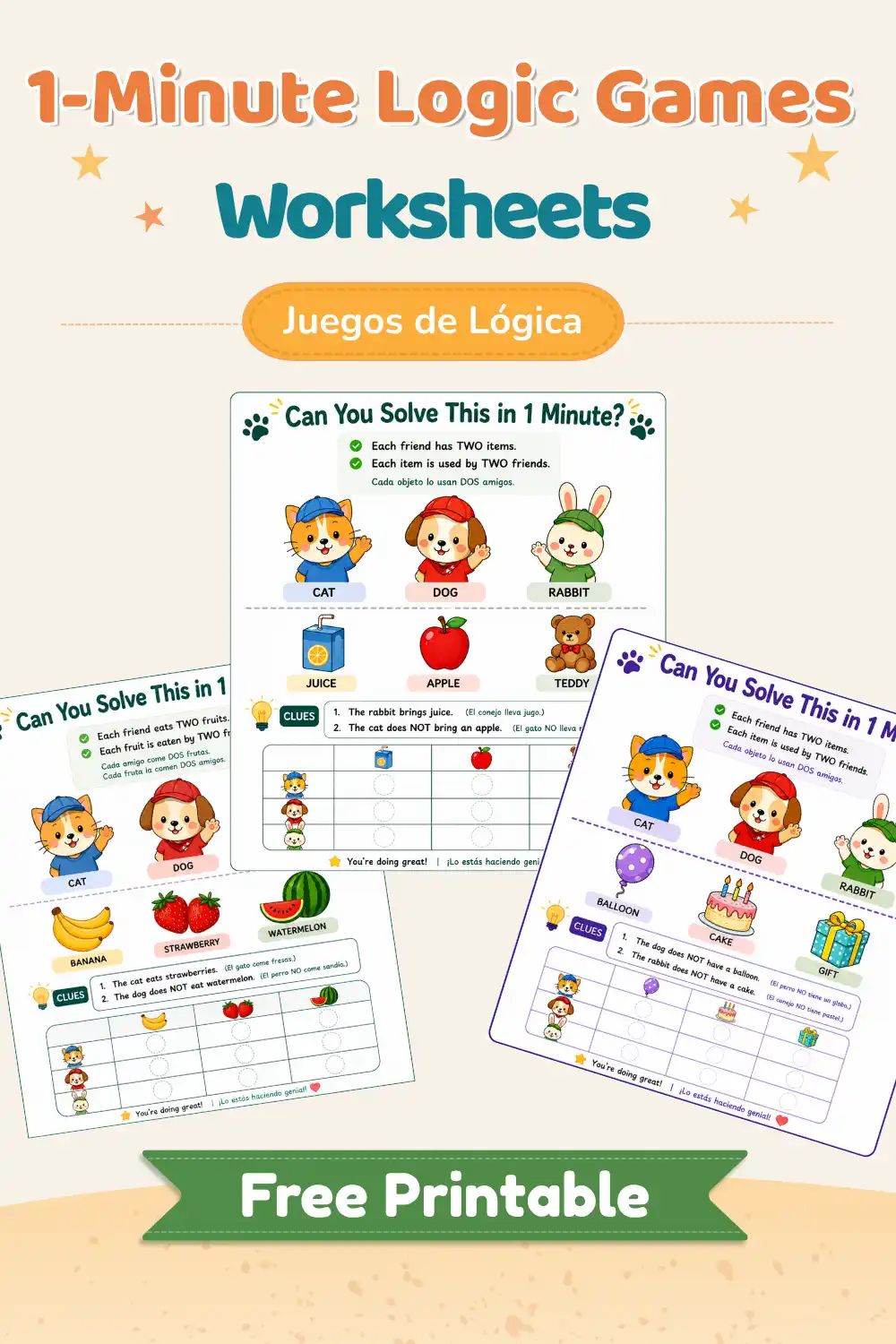
Free Printable Download
Free
Spanish & English
What’s Inside This Collection
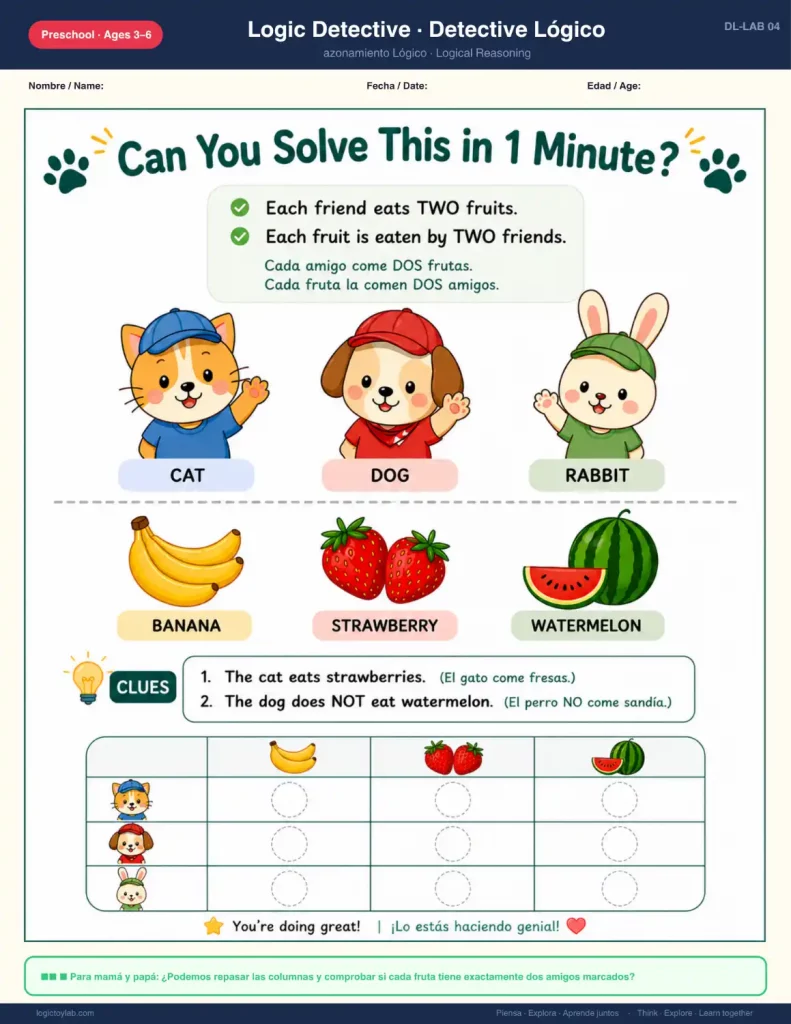
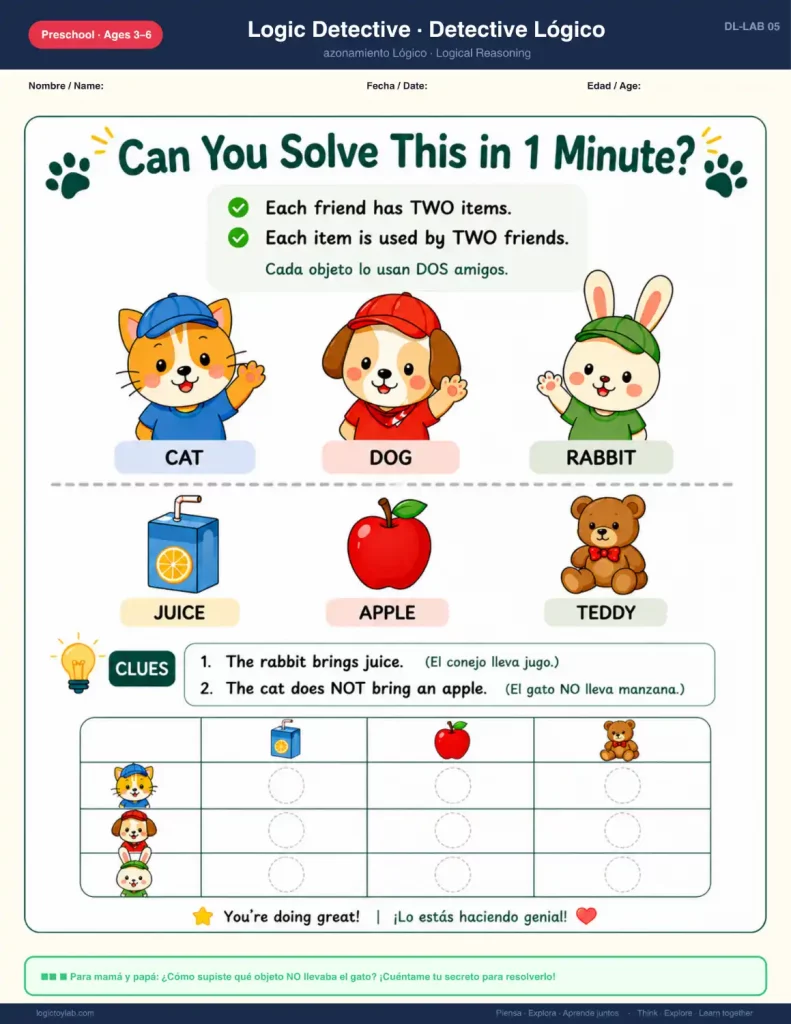
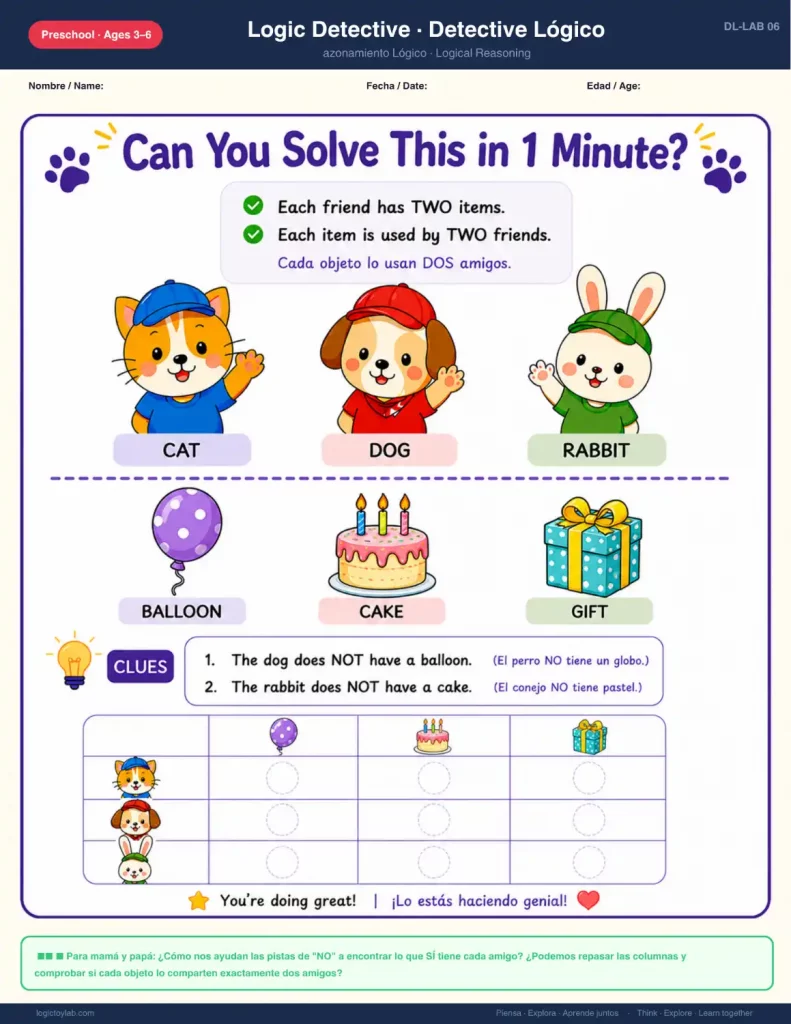
Printable logic grid puzzles that use clues and deduction
Two clues on every worksheet: one positive clue and one negative clue
Three familiar characters: Cat, Dog, and Rabbit
A consistent puzzle structure that helps children build confidence
Bilingual instructions on every page (English + Spanish)
Optimized for: Perfect for home learning, classrooms
What Is a Logic Grid Game — and Why Is It So Powerful?
Many young children love solving little mysteries. That’s why we created this collection of logic grid puzzles for preschoolers.
Each puzzle asks children to use clues to determine which items belong to which character. As they work through the clues, they record their answers in a simple grid.
The format may look advanced at first, but every worksheet follows two consistent rules:
Each character has two items. Each item belongs to two characters.
Using those rules and the provided clues, children can solve the entire puzzle through logical reasoning.
This type of thinking—reading conditions, comparing information, and drawing conclusions—forms an important foundation for later math, science, and problem-solving skills. Many children are ready to begin practicing these skills as early as age four. a seamless fit for both homeschooling parents and classroom teachers. siendo ideales tanto para hacer en casa como para usar en el aula.
👉 [Read: I Was Annoyed at My Toddler’s Screen Time—Until I Realized I Was the Problem]
What Skills Does This Activity Build?
These printable logic puzzles develop multiple skills at the same time:
- Reading and Following Clues
Children learn to carefully interpret written information before making decisions. - Using a Grid to Organize Information
Logic grids teach children how to sort and track information visually—a skill used throughout math, science, and critical thinking activities. - Flexible Reasoning
Combining positive and negative clues encourages children to think from multiple angles rather than relying on guessing. - Self-Monitoring
Children must pause, check their work, and verify conclusions before moving on. - Bilingual Vocabulary Development
Every object and clue appears in both English and Spanish, allowing children to learn vocabulary in a meaningful context.
How to Use This Worksheet at Home
Make the First Puzzle Easier – Read the clues aloud together before your child begins.Ask questions such as:
“If the rabbit has the juice box, which square should we mark?”
One guided puzzle is often enough to help children understand the process.
Make It More Challenging – Read the clues once, then cover them.
Your child must remember the information while solving the puzzle.
A Small Tip That Makes a Big Difference – If your child starts guessing, avoid correcting them immediately.
Instead, ask:
“What did the first clue say? Does that match the answer you chose?”
The habit of checking work is one of the most valuable skills these puzzles help build.
🧸 Want to take the learning further? The right hands-on toy can reinforce what these worksheets build — and keep the momentum going between sessions. See our full guide: Best Toys for Building Concentration in Children Ages 3 to 6
My Child Solved These Shadow Worksheets Easily. What’s Next?
That’s a great sign.
Your child may be ready for more advanced logic challenges, including:
- Logic grids with four characters and four objects
- Three clues instead of two
- Multi-step deduction puzzles
- More complex combinations of positive and negative clues
You can also encourage your child to create their own puzzle.
Ask them to choose three characters, three objects, and write two clues. Designing a puzzle requires even deeper logical thinking than solving one.
Frequently Asked Questions
Are these printable logic puzzles really free?
Yes. All worksheets can be downloaded at no cost and without creating an account.
What do I need to print them?
Any standard printer and letter-size paper will work.
Color printing is recommended for the best experience, but the puzzles remain easy to use in grayscale.
What age are these puzzles designed for?
These logic puzzles are designed primarily for children ages 4–6.
Because the puzzles include written clues, children should either be able to read simple instructions independently or work with an adult who can read the clues aloud.
Ages 4–5: Adult guidance is recommended for the first puzzle.
Ages 5–6: Most children can solve the puzzles independently after one guided example.