
The Day I Saw What My Perfectionism Was Doing
I remember the exact moment I realized my parenting perfectionism was hurting my child. It was a Tuesday, 4:47 PM, and I was crouched on the kitchen floor throwing half-eaten organic sweet potato fries into the trash. My three-year-old had just flung his plate across the room. He was crying. I was crying. Both of us were drowning in emotions neither of us could name.
I had spent the whole day trying to be the Pinterest mom. Sensory bin. Calm voice. Only open-ended wooden toys. I’d read every parenting article, followed the gentle parenting accounts, memorized the scripts. “I see you’re feeling frustrated. It’s okay to have big feelings.” But when he chucked that sweet potato, something snapped. Not at him—at myself.
“What am I doing wrong?” I whispered to the empty kitchen. And then a quieter question followed: “What am I teaching him?”
The Anxious Loop We Were Both Stuck In
Here’s what I didn’t want to admit: my four-year-old wasn’t acting out because he was difficult. He was acting out because he could feel my anxiety. He’d look at me after spilling milk, and his face would fall. He’d scan my expression looking for worry. And some days, I was vibrating with it.
My perfectionism made me watch him like a scientist analyzing an experiment. Did he speak kindly? Hold his crayon correctly? Accept the wrong color cup without melting down? Every small behavior had weights attached to it, in my mind. If he wasn’t perfectly regulated, I wasn’t perfectly parenting. And if I wasn’t perfectly parenting, I had failed him.
But kids don’t need perfect parents. They need real ones. And the pressure to be flawless was actually pushing us apart instead of bringing us together.
A child who feels watched all the time begins to feel like a project, not a person.
Perfection isn’t protection. It’s pressure.
I started noticing the tiny signs I’d been ignoring. He’d hide his drawings before showing them to me. He’d ask “Are you happy with me, Mama?” forty times a day. He was terrified of making mistakes because I had accidentally taught him that mistakes were emergencies.
Here’s what I wish every overwhelmed parent could understand: preschoolers don’t need perfectly executed calm-down corners. They need permission to be messy, loud, and unfinished.
What looked like him being defiant was really just him trying to catch his breath.
Seeing His Behavior Through His Eyes
One evening, I sat on the edge of his bed after a particularly rough bedtime. He had refused pajamas. Refused teeth brushing. Refused everything. I felt rage simmering under my ribs. But instead of pulling out my perfect parenting scripts, I just sat still and watched his breathing.
It was fast. It was shallow. He was small in his dinosaur pajama shirt, clutching a stuffed giraffe.
“Honey,” I said quietly, “are you afraid you’re going to make a wrong choice?”
He looked up at me, eyes wet. “I don’t know what you want, Mama.”
That broke me open.
My child wasn’t refusing to cooperate. He was trying to survive my expectations.
He didn’t need a better routine or a sticker chart. He needed to feel like he wasn’t being evaluated every single second. My anxiety had become his. My perfectionism had become his.
What controlling our children really costs them
When we over-parent with perfectionism, we’re not teaching self-discipline. We’re teaching self-doubt. My son’s explosive moments decreased dramatically once I stopped tracking his every win and loss. The tantrums didn’t vanish overnight—some days they still show up—but the intensity changed. The desperation faded. He started playing alone more, painting without narrating every stroke, making messes without waiting for my reaction.
He was learning he could be himself without me hovering over him like a coach.
Perfectionism in parenting doesn’t produce perfect children. It produces anxious ones.
And I was the proof.
What Helped Us Instead
It wasn’t a magic solution. It wasn’t a checklist or a 30-day challenge. What helped us was uglier and slower than that.
Honestly? What helped was me genuinely apologizing when I snapped and saying “Mama was trying too hard today, and I’m sorry. I love you just the way you are.” Real conversations on bath mat borders. Breaking my phone habit so I wasn’t scanning parenting advice in front of him.
I also started paying attention to how often I interrupted his play to praise him. Not all praise is bad! But constant evaluation—even the positive kind—teaches kids that their value comes from someone else’s opinion. So I’d whisper “you’re figuring that out all by yourself” instead of “good job!” I started biting my tongue when he colored outside the lines. I started breathing when he spilled things.
None of this happened fast. Some afternoons I still caught myself trying to steer him toward the “right” activity like a tiny human GPS. My default setting was control.
But every time I chose presence over perfection, I saw him exhale.
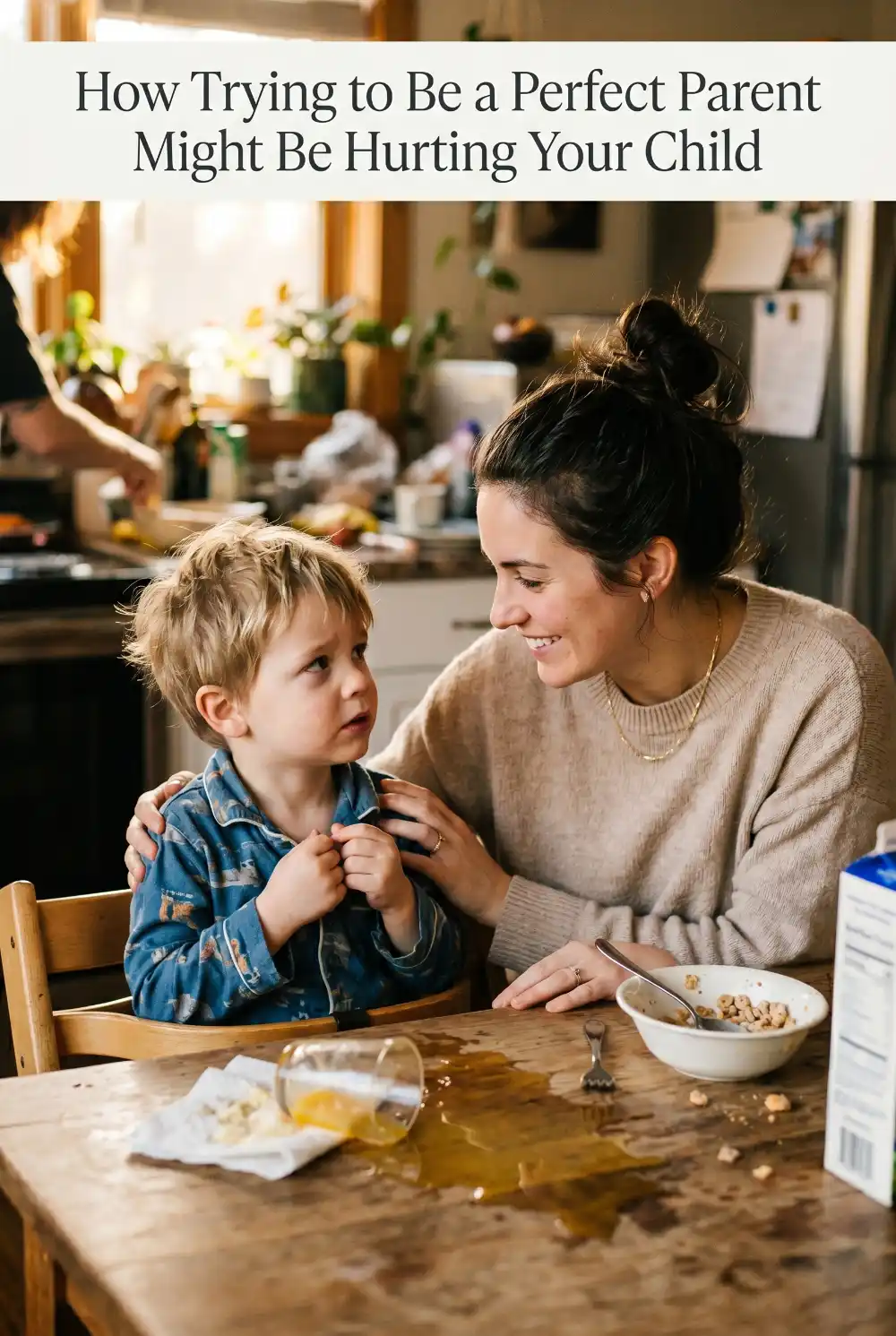
One day after breakfast he bumped his glass of orange juice over. Juice ran across the table, dripped off the edge onto his lap, and created a puddle on the floor. He looked at me. I looked at him. And for the first time in months, he grinned. “Uh-oh, Mama. Mess!”
He wasn’t scared. He was free.
And that’s exactly what I wanted all along.
Parenting perfectionism doesn’t harm because of the rules you follow.
It harms because of what your child starts telling themselves about you in their own small heart.
Some kids need us to lower the bar—not because they can’t reach it, but because they need to know we love them even when they don’t.