The first time I seriously considered homeschooling, I sat on my kitchen floor and cried. Not because I thought it was a bad idea. Because I was staring at a pile of unwashed laundry, three half-eaten granola bars stuck to the counter, and a preschooler who had just dumped an entire box of Cheerios onto the linoleum for the sole purpose of watching them bounce.
I am not organized. I have never been organized. My to-do lists have to-do lists, and I lose those lists twice a week. My son, who was four at the time, has ADHD — which means his brain moves like a pinball machine dipped in lightning. And I had the audacity to think I could teach him at home?
The homeschooling anxiety hit me like a truck. It whispered that I wasn’t structured enough, disciplined enough, or put-together enough to give him a real education. That I would fail him. That he would end up behind. That the other homeschool moms with their color-coded bins and laminated schedules would look at me and just know.
The Morning I Almost Quit Before We Started
It was a Tuesday in August. I had printed out a beautiful, free preschool curriculum. I bought a little wooden calendar with movable numbers and weather cards. I cleared the dining room table and laid out crayons, scissors, and glue sticks in neat little bowls.
We lasted seventeen minutes.
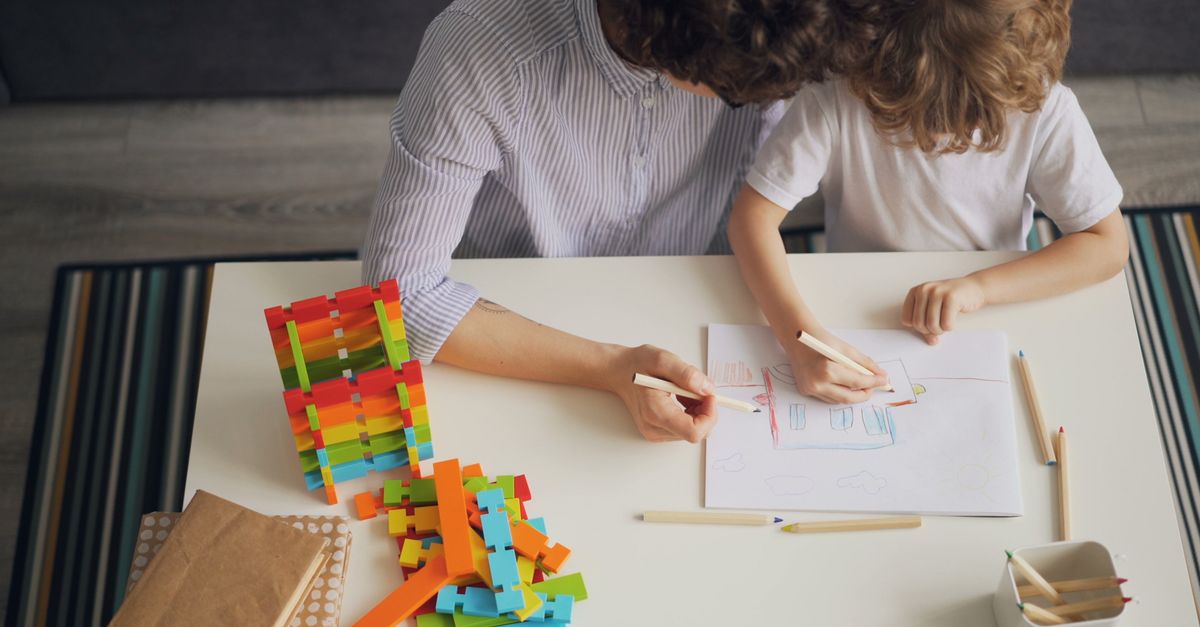
My son looked at the calendar for about four seconds before asking if he could eat the number 12. Then he noticed a spider on the ceiling and spent the next ten minutes narrating a dramatic story about the spider’s secret life. By minute fifteen, he was under the table pretending to be a mole. And by minute seventeen, I was on the verge of tears because I could not get him to trace the letter A.
That evening, I texted my sister: I’m not organized enough to homeschool. I think we need to accept that.
She texted back: Did he learn anything today?
I thought about it. He learned that spiders have eight legs. He learned that moles dig tunnels. He learned that Cheerios bounce higher if you drop them from the counter instead of the table. He learned that his mom gets a certain look in her eyes when she’s trying to force something that isn’t working.
And I learned something too. I learned that my definition of education was way too small.
What I Thought Homeschooling Required
When I pictured homeschooling, I pictured a perfectly quiet room with a chalkboard and alphabet posters. I pictured a child sitting still, pencil in hand, following a schedule written in neat block letters. I pictured a mom who had her act together — who remembered to buy glue sticks before the art project, who had a plan for every hour, who never lost her temper because she was so calm and prepared.
I was comparing my real, messy, neurodivergent life to a fantasy. And that fantasy was making me feel like a failure before I even started.
The homeschooling anxiety and self-doubt I felt wasn’t really about whether I could teach. It was about whether I could become someone I wasn’t — a structured, organized, predictable person. And the answer to that felt like a hard no.
But here’s the thing I didn’t understand yet. My son didn’t need a structured, organized, predictable mom. He needed his mom. The one who sits on the floor with him. The one who follows his spider tangents. The one who lets him be a mole under the table for a while, because maybe that’s where the learning is happening anyway.
What the Research Actually Says (But I Had to Learn the Hard Way)
I eventually stumbled onto something that changed my perspective. It wasn’t a curriculum or a schedule. It was an understanding of how young children — especially neurodivergent ones — actually learn.
Preschoolers don’t learn through worksheets. They learn through play, through movement, through following their curiosity. And a child with ADHD doesn’t need more structure. They need responsive structure — a framework that bends when they need to bounce, that follows their focus instead of forcing it.
I read somewhere that some children don’t hate learning. They hate feeling controlled. That hit me hard. My son wasn’t refusing to trace the letter A. He was refusing to be forced into a shape that didn’t fit him.
I realized that my homeschooling anxiety and self-doubt were coming from a place of trying to force both of us into a mold that wasn’t ours. I was so afraid of doing it wrong that I couldn’t see what was already right in front of me.
The Day I Let Go of the Schedule
One morning, I decided to try something different. Instead of pulling out the curriculum, I just sat on the living room floor with a stack of picture books and a basket of random stuff — measuring cups, pinecones, a magnifying glass, some old keys.
My son came over, picked up the magnifying glass, and spent twenty minutes examining the carpet fibers. Then he found a pinecone and wanted to know why it had scales. We counted the scales together. We talked about trees. We drew a pinecone with crayons. He asked if pinecones had babies, which led to a conversation about seeds, which led to us going outside to find more pinecones, which led to him jumping in a pile of leaves for no reason other than it felt good.
We never opened the curriculum that day. But we learned about measurement when he wanted to know how many pinecones fit in the measuring cup. We learned about texture and observation. We learned about ecosystems. We learned about joy.
And I learned that this — the messy, unpredictable, following-their-lead kind of learning — was not a failure of homeschooling. It was homeschooling.
What My Son Actually Needs From Me
Over time, I started to realize that my son’s behavior wasn’t a problem to be fixed. It was a signal. When he couldn’t sit still, it wasn’t because he was being defiant. It was because his body needed to move. When he couldn’t focus on the letter A, it wasn’t because he wasn’t smart. It was because his brain was wired to notice everything at once — and a spider on the ceiling was simply more interesting.
I started to see his distractibility as a strength instead of a weakness. He notices things I would never see. He makes connections I would never make. He lives in a world of rich, vibrant detail, and I had been trying to shrink him down to fit inside a worksheet.
The homeschooling anxiety and self-doubt started to fade when I stopped measuring myself against a standard that wasn’t designed for us. I stopped trying to be the organized homeschool mom and started trying to be the present one. The curious one. The one who says, Tell me more about that spider.
I’m not saying it’s easy. Some days, nothing works. Some days, he’s dysregulated and I’m dysregulated and we both end up on the couch eating crackers and watching Bluey. Some days, I still look at those Pinterest-perfect homeschool rooms and feel a pang of inadequacy.
But I’ve learned to whisper back to that voice: Maybe. But my kid doesn’t need a perfect room. He needs a mom who sees him.
Redefining What ‘Enough’ Looks Like
I think a lot of parents carry this quiet fear that they aren’t enough. That they don’t have enough patience, enough knowledge, enough organization. And for parents considering homeschooling, that fear gets amplified by a thousand.
But here’s what I’ve come to believe. Your child doesn’t need you to be a teacher. They need you to be a guide. A witness. A safe place to land when the learning gets hard.
What looked like bad focus was sometimes just boredom with the wrong approach. What looked like defiance was sometimes just a need for autonomy. What looked like my failure was sometimes just my child asking to be met where he was.
I am not organized enough to homeschool — if organized means having a color-coded schedule and a laminated calendar. But I am curious enough. I am present enough. I am willing to sit on the floor and follow a pinecone trail enough. And that, I’ve learned, is what my son actually needs.
So if you’re sitting on your kitchen floor right now, surrounded by laundry and half-eaten snacks, wondering if you have what it takes to teach your child at home — I see you. And I want you to know that the homeschooling anxiety you feel is not a sign that you’re not cut out for this. It’s a sign that you care deeply. And that caring is the most important thing you bring to the table.
You don’t need to be perfectly organized. You just need to be willing to learn alongside them. And that, my friend, is something you already know how to do.
What Helped Us Instead
What finally helped wasn’t a system or a product. It was a mindset shift. I stopped trying to teach my son and started trying to notice him. I began paying attention to what he was drawn to naturally — the patterns he noticed, the questions he asked, the things he wanted to investigate with his hands.
Instead of forcing him into a curriculum, I started following his observations. We did more looking, more wondering, more talking about what we saw. It felt slow and unimpressive at first. But over time, I realized that this kind of observation-based learning was teaching him something far more valuable than letters and numbers. It was teaching him that his curiosity mattered.