
Does your child get confused by activities like 🔵🔴🔵🔴?
You’re not alone — and neither is your child. Many preschoolers struggle with pattern recognition at first, and that’s completely normal. Pattern recognition is one of the earliest logical thinking skills, and like all skills, it develops gradually.
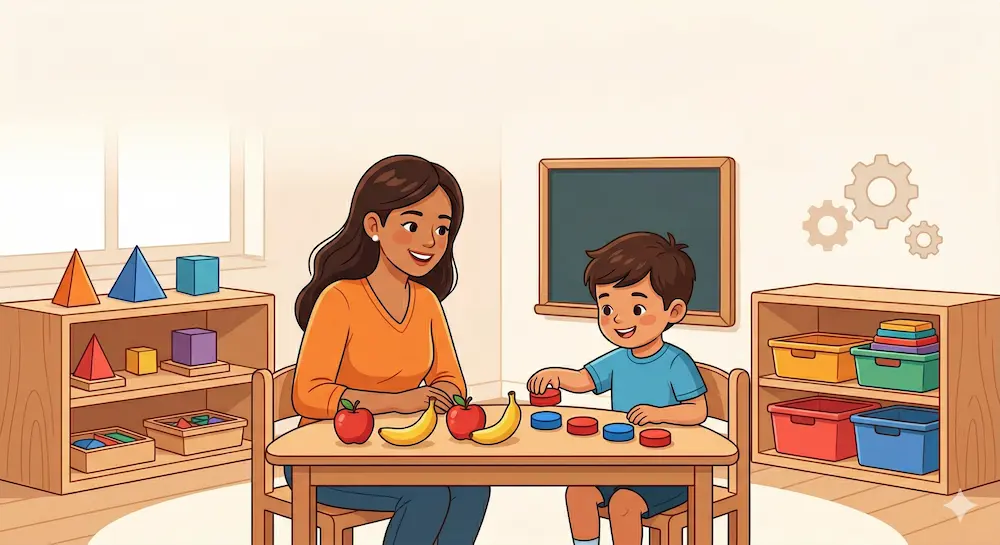
The learning happens when a child discovers the rule on their own. Your job isn’t to explain it — it’s to create the right conditions for that moment to occur.
Why Do Some Children Find Patterns Difficult?
There’s almost always a specific reason, and it usually has nothing to do with intelligence. Here are the three most common ones:
1. They’re still building their color and shape vocabulary. If a child can’t reliably distinguish between colors or shapes yet, seeing what repeats in a sequence becomes nearly impossible. The logical challenge can’t be addressed until the visual foundation is in place.
2. Visual memory is still developing. Recognizing a pattern requires holding the beginning of the sequence in mind while looking at the rest. That short-term visual memory is still being built at ages 3 to 5.
3. Sustained attention is a new skill. Following a sequence from start to finish requires staying focused for more than a few seconds — something many preschoolers are only just beginning to practice.
Understanding which of these is the actual obstacle makes it much easier to choose the right activity.
How to Help Your Child at Home — Step by Step
Step 1: Start with AB Patterns — and Only AB Patterns
Before introducing anything more complex, make sure the most basic pattern type feels completely natural to your child.
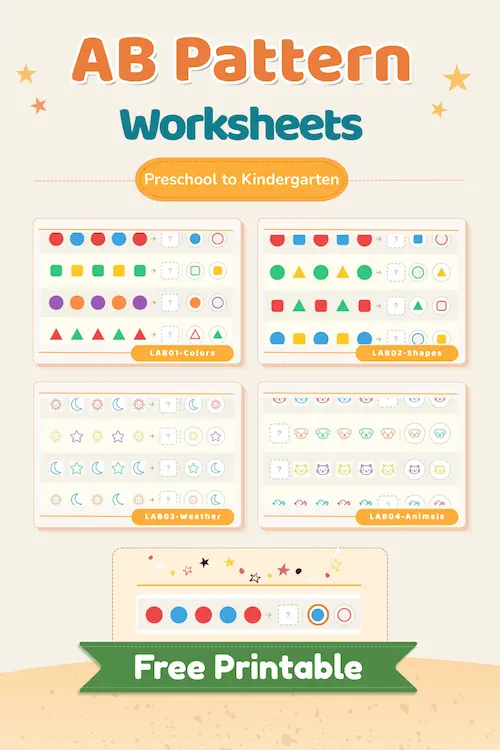
An AB pattern alternates between exactly two elements: 🔵🔴🔵🔴 / 🐱🐶🐱🐶 / ⬛⬜⬛⬜
When you work on one together, resist the urge to explain the rule. Instead, ask:
- “What do you think comes next?”
- “How did you know?”
That second question is the one that matters most. Getting the right answer is good. Being able to explain why is where real logical thinking begins.
👉 [Download free: AB Pattern Worksheets — Preschool Printable]
Step 2: Use Real Objects Before Paper
Young children learn through their hands before they learn through their eyes. A pattern on a worksheet is abstract. A pattern made of actual objects is something a child can touch, move, and rebuild.
Try it with things you already have at home:
- Blocks or LEGO pieces in alternating colors
- Small toys arranged in a repeating sequence
- Fruit or snacks at the table: 🍎🍌🍎🍌
Once your child can build and extend a pattern with objects, transferring that understanding to paper becomes much easier.
Step 3: Move Forward Only When AB Feels Easy
When your child completes AB patterns quickly, without hesitation, and can explain the rule in their own words — that’s the signal to introduce the next level.
The progression looks like this:
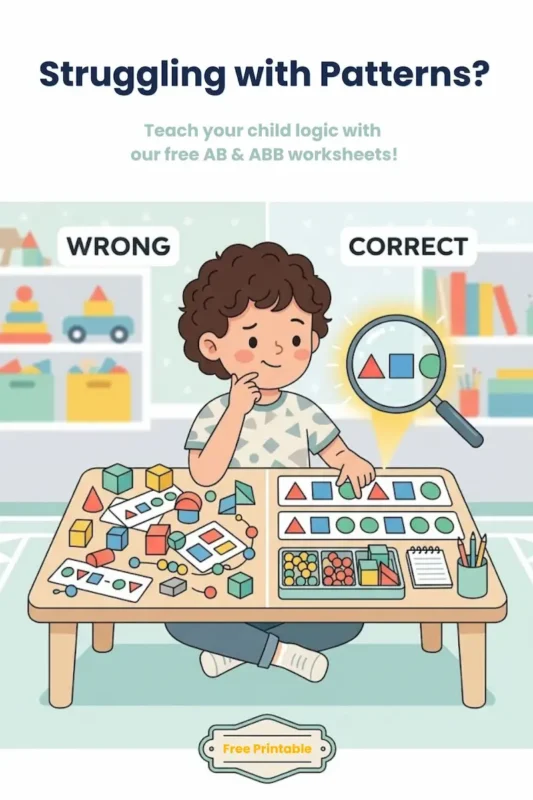
- ABB — two of one element, one of another: 🔵🔴🔴🔵🔴🔴
- ABC — three different elements in sequence
- Missing piece — a gap somewhere in the middle of the pattern, not just at the end
Each step is a genuine cognitive jump. Rushing ahead before the previous level is solid tends to create frustration rather than progress.
👉 [Download free: ABB Pattern Worksheet — Preschool Printable]
Step 4: Bring in Toys for Hands-On Practice
Printable worksheets are excellent for building pattern recognition. But physical toys add something paper can’t: the ability to construct, rearrange, and self-correct in real time.
The toys that work best for pattern practice are ones with clearly distinct pieces — different colors, shapes, or sizes — that children can arrange into sequences independently:
- Building blocks and construction sets
- Colored sorting tiles
- Attribute blocks with varied shapes and colors
👉 [See our full guide: Best Pattern Toys for Kids Ages 3–6]
At What Age Do Children Learn Patterns?
These are general guidelines — every child develops at their own pace:
- Ages 3–4 → AB patterns (two alternating elements)
- Ages 4–5 → ABB patterns (two of one, one of another)
- Ages 5–6 → ABC patterns and missing-piece variations
If your child is on the later end of these ranges, that’s not a problem. It means they need more time at the current level — not that they’re behind.
Is It Normal That My Child Doesn’t Get It Yet?
Yes. Completely normal.
Pattern recognition builds in layers. Some children pick it up quickly; others need several months of gentle, consistent practice before it clicks. The research on early math development is clear: children who are given time and low-pressure exposure almost always catch up — and the ones who were pushed too quickly often develop avoidance around math activities.
What matters most:
- Short practice sessions — 5 to 10 minutes is genuinely enough
- Keeping it playful and pressure-free
- Celebrating effort, not just correct answers
Frequently Asked Questions
How long should we practice each day? 5 to 10 minutes is sufficient — and often more effective than longer sessions, because attention at this age is naturally short. Consistency over time matters more than duration in any single sitting.
Do I need special materials? No. You can start with household objects, fruit, or small toys. Printable worksheets are free and require nothing beyond a printer and a pencil.
What if my child gets frustrated and refuses to try? Step back one level. Frustration almost always means the current activity is slightly beyond where the child actually is. Going back to something easier isn’t regression — it’s the right instructional move.
Where to Start Today
Logical thinking doesn’t develop overnight. But with short, consistent practice and activities matched to your child’s current level, it develops reliably — and more quickly than most parents expect.
The best starting point is always the simplest activity your child can succeed at with a little effort. Build from there.
👉 [Download free AB Pattern Worksheets — start today]
👉 [See the full printable pattern series — organized by level]
LogicToy Lab | Bilingual early thinking activities for Spanish-speaking families in the United States. Free resources for children ages 3 to 6. No sign-up required.