
My 4-Year-Old Hates Worksheets: What to Do When Your Child Refuses Structured Learning
It was a rainy Tuesday afternoon, and I was standing over the kitchen table with a worksheet that had a big, smiling sun on top and a row of lowercase letters underneath. My four-year-old took one look at it, pushed it off the table, and said, “No.” Not a whine, not a negotiation—a flat, deliberate refusal. I felt my chest tighten. Was I pushing too hard? Should I just let him play? The guilt sat heavy, like I was failing at parenting and preschool prep at the same time.
Then he picked up a puzzle piece from the floor—one of those chunky wooden ones that usually lived under the couch—and started fitting it into a shape. No prompting from me. No pressure. Just him, figuring out where the piece went, tongue sticking out, completely absorbed. I realized something in that moment: Some preschoolers don’t hate learning. They hate feeling controlled.
For weeks, I’d been buying preschool workbooks and printing cute worksheets from Pinterest. But every time I brought one out, my son’s whole body went stiff. He’d complain of a stomachache, or suddenly need to pet the cat, or drop the pencil after two scribbles. I thought he had a focus problem. I thought maybe he wasn’t ready for preschool concepts. I started worrying about kindergarten, about screen addiction, about all the ways I was failing him.
What Was Really Going On
Here’s what I slowly figured out, sitting on the floor surrounded by mismatched puzzle pieces and broken crayons: Worksheets made my son feel watched. Puzzles made him feel curious. When he sat down with a worksheet, every mark felt like a test. I would—without realizing it—hover behind him, peering over his shoulder, waiting for the right answer. He could feel my eyes on his back. That pressure shrunk his world. On the other hand, when he found a logic game—a matching game, a simple maze, a tangled-up visual puzzle—he got to think for himself. He had the space to be wrong without a grade.
My son isn’t the only kid who works this way. Some preschoolers don’t struggle with learning. They struggle with sitting still for a task that doesn’t feel like play. They’re wired to move, touch, figure things out with their hands, and discover patterns through trial and error. A worksheet is the opposite of how their brain wants to work.
And this explains why so many screen-obsessed kids actually behave differently than you’d expect. I always thought screens made my son lazy, but I noticed something weird: when I let him have his iPad, he’d stare at it—passive. His brain was off. But the moment I turned off the screen and put a chunky wooden puzzle in front of him, he came alive like a detective solving a mystery. He started narrating his own thinking: “This piece has a pointy bit, so it won’t fit here…” Sitting still on the floor with a puzzle is more interactive, more mentally demanding, than swiping through YouTube videos. He didn’t need less stimulation. He needed more of the right kind—the kind where he leads, not follows.
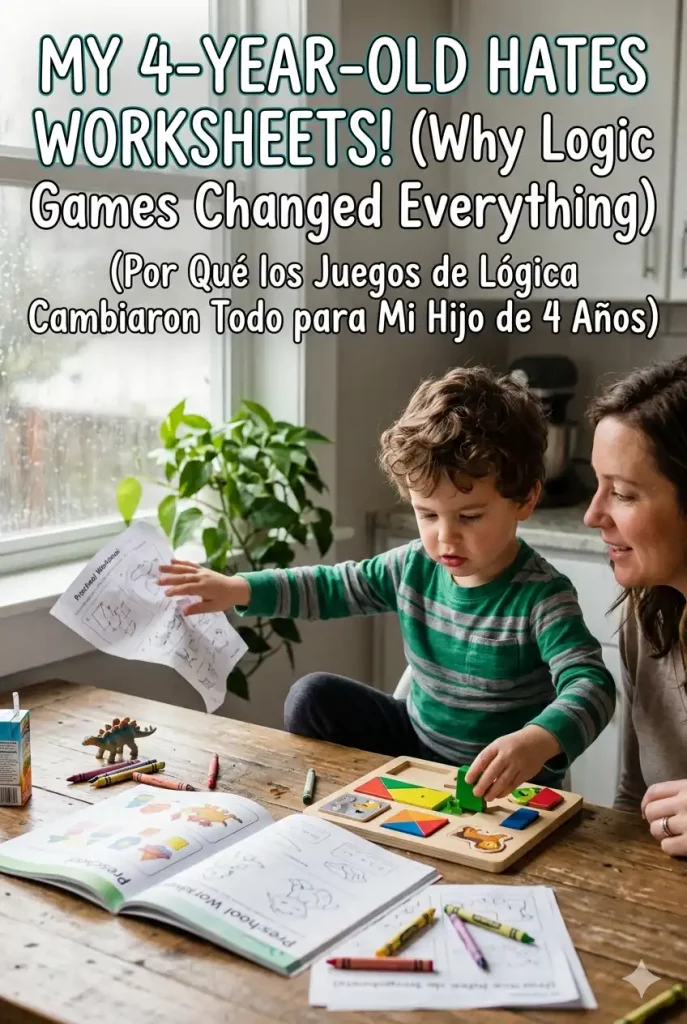
Why Logic Games Changed the Game for Us
The kids who crash with worksheets are often the ones who crave novelty, puzzles, and challenge. They’re not avoiding hard work—they’re avoiding boring work. When I finally found preschool logic games screen free activities, it clicked. A simple maze printed on a scrap of paper with a crayon path? My son would spend ten minutes tracing it, whispering, “The bear has to go through the forest…” A matching game where he had to pair socks by pattern? He’d get excited about finding the right pair. Logic games worked because they offered three things worksheets couldn’t give: challenge without evaluation, movement without restraint, and a clear visible victory at the end that my son got to claim as his own.
One of the easiest things I did was print out a ‘choice board’ printable with three to four low-pressure logic activities—a simple maze, a matching game, a cut-and-paste pattern, and a picture sequencing puzzle. I’d lay it on the kitchen table next to some colored pencils, and I’d tell him: “You can pick one if you want. Or none. That’s okay.” Handing over the control was key. When he felt like he wasn’t forced, he almost always chose one. And once he chose, sometimes he’d finish in two minutes, sometimes ten minutes. But those ten minutes—often while I tried to make dinner—were golden. The ‘printable’ wasn’t about teaching him letters. It was about letting his brain crack a code for fun.
A note of honesty: it’s not magic every day. On some rainy afternoons, my son dumps the pieces of a 24-piece jigsaw on the tile floor before I’ve even had coffee, walks away, and doesn’t come back. Toys get abandoned mid-game. Puzzle pieces will ride under the couch cushions for weeks. I still lose patience, raise my voice, and close the refrigerator door louder than I mean to. Screens are a hard habit to break, and sometimes the only thing that works is giving up for a day and starting fresh tomorrow. Progress is inconsistent, and that’s normal.
The most important realization I had about my preschooler’s brain: My child wasn’t refusing learning. He was refusing pressure. When I stopped making worksheets into a test—when I just laid out the same concepts as a logic puzzle or matching game without demanding participation—he started wanting to do them. He didn’t change. I did. And that change started with understanding that some kids need challenge more than compliance, curiosity more than practice, and space more than scaffolding. Boredom isn’t a sign they hate learning; it’s a sign they’re ready for a different kind of problem to solve.
Now, I keep a small folder of low-stakes activities on the counter—things like simple logic toys and those printable choice boards from Logic Toy Lab. They’re survival tools, not educational products. They exist so I can make a phone call, chop vegetables, or just breathe for ten unhappy seconds. They work about sixty percent of the time. On the days they don’t, my son sits on my foot while I chop vegetables, and I remind myself: he’ll learn to read one day. He’ll recognize numbers. But more than anything, he needs to know that being challenged doesn’t always feel like being evaluated. Some kids just need to figure it out in their own time. And that’s okay.
Wrapping Up With Honest Hope
So if your four-year-old hates worksheets, you’re not a bad parent. You haven’t ruined their education. You haven’t failed preschool prep. You’re probably just raising a kid who needs to lead his own thinking. Who hears the words “Now trace the letter P” and feels like the whole room is watching. Who wants to discover, not perform. And who, on the days it works, will sit so still and silent working through a maze that you’ll check if he’s still breathing—because nothing in parenting is more surprising than the sudden, precious quiet of a deep-thinking preschooler.
Try a very low-stakes approach: a cheap puzzle from the thrift store, a building game where your child guesses the pattern next, or just my absolute mundane rainy-day back-up: the free choice board printable from Logic Toy Lab. And on the days your kid ignores it entirely and asks for their tablet instead? That also counts as parenting. Some days you just survive. Others, you catch them murmuring under their breath while solving a maze and realize that your child’s frustration wasn’t about being incapable. It was about being controlled. That’s the hardest part to admit as a parent—the part where the problem was never our child being ‘difficult’ but being completely unseen. But once you start seeing them differently, the whole game changes.
And that’s really all any of us can do: try again, be patient with ourselves, and keep plenty of puzzles under the couch.