
You set up what felt like a perfect activity. New puzzle, their favorite animal theme, not too hard. You stepped away to grab a glass of water and came back to find the puzzle pieces scattered across the floor and your child on the couch watching you with that expression — the one that says I already decided it’s not happening.
Two minutes. Maybe three.
If you’ve been there — and if you’re reading this, you probably have — you know the particular exhaustion of watching your child give up on something before they’ve really started. You wonder if they’re just bored. Or maybe it’s something you did. Or didn’t do. Or maybe it means something about how they’re going to handle harder things later.
Here’s what I want you to hear first: it almost certainly doesn’t mean what you think it means.
What’s Really Going On When a Preschooler Gives Up Fast
When a child who is 3, 4, or 5 years old hits a wall and walks away, it looks like quitting. From the outside, it can feel like laziness or defiance or a short attention span. But most of the time, what you’re actually watching is a child who has run out of a very specific resource: tolerance for not knowing what to do next.
That’s different from giving up. It’s more like a circuit breaker tripping.
Young children are working extremely hard, cognitively, during every waking hour. They’re processing language, figuring out social rules, making sense of physical space, and managing emotions that are genuinely new to them. When you add a task that requires sustained focus and produces frustration before it produces results — like a puzzle, or a pattern worksheet, or a building challenge — some kids hit their limit fast.
It is almost never about intelligence. Some of the most capable, creative children struggle the most with persistence early on, precisely because their minds are busy in other ways.
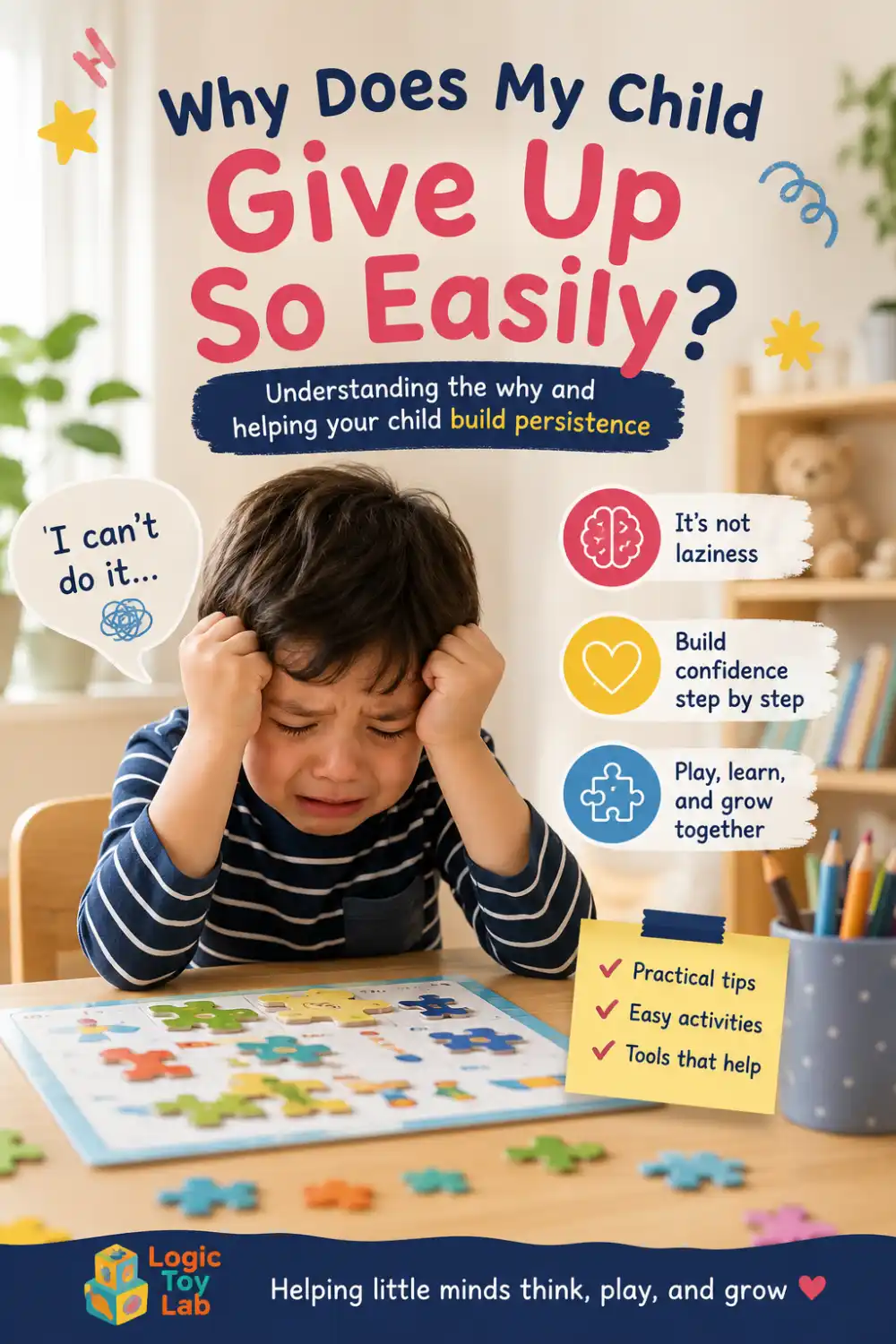
The “I Can’t Do It” Moment
If your child has ever looked at something and said “I can’t do it” before seriously trying, you’ve witnessed what happens when the fear of failing feels bigger than the possibility of succeeding.
This is developmentally very common in preschool-aged children. Their self-awareness is developing rapidly — they can now notice that other people do things better than they can — but their understanding of how learning actually works hasn’t caught up yet. They don’t yet know, in a felt sense, that not being able to do something right now doesn’t mean they can’t learn to do it.
So they protect themselves the only way they know how: by opting out before the failure becomes official.
The goal isn’t to push through this or lecture around it. The goal is to gradually change the internal calculation — so that trying starts to feel safer than not trying.
What Doesn’t Help (Even Though It Feels Like It Should)
Encouraging words in the moment, delivered while your child is already mid-quit, rarely land the way we hope. “You can do it! Just try harder! Don’t give up!” usually gets absorbed as pressure rather than support — and pressure is exactly what triggered the shutdown in the first place.
Same with making the task easier on the fly. If your child is struggling with a puzzle and you immediately swap it for a simpler one, the message received — however unintentional — is that you also weren’t sure they could handle it.
None of this means you’re doing it wrong. These responses are completely natural. They just don’t move the needle on the underlying thing.
What Actually Helps: Building the Muscle Before They Need It
Persistence isn’t a personality trait some kids are born with and others aren’t. It’s a skill. And like any skill, it develops through practice — in low-stakes situations, before the frustration hits.
Start smaller than feels necessary. If a puzzle with 20 pieces leads to a quit, try 8 pieces. Not as a permanent solution, but as a starting point. You’re not lowering the bar — you’re establishing a baseline of “I finished something.” That feeling of completion is the actual building block of persistence.
Celebrate the attempt more than the outcome. This one sounds simple and kind of obvious, but the specific way you celebrate matters. “You kept going even when it was hard” hits differently than “Good job finishing!” The first one names the behavior you want to reinforce. The second one focuses on the result, which a child who struggles with persistence will file under “I got lucky this time.”
Let them watch you get stuck. When your child sees you try something that doesn’t work immediately — and sees you pause, adjust, and try again without drama — they’re absorbing information about what trying actually looks like. This is one of the most underrated tools available, because it costs nothing and doesn’t require any setup.
Activities That Build Persistence Without Feeling Like a Lesson
The right activity at the right level does something magical: it creates just enough challenge to require effort, but not so much that the child shuts down before getting traction.
Simple logic games work especially well for this. Think matching games, detective-style “who took it?” puzzles with picture clues, or basic sorting challenges. These activities have a clear structure and a clear endpoint — which means a child can actually complete them and feel the satisfaction of being done. That completion loop, repeated over time, is what builds confidence and the willingness to persist.
👉 [Logic Detective Games — free printable for preschoolers]
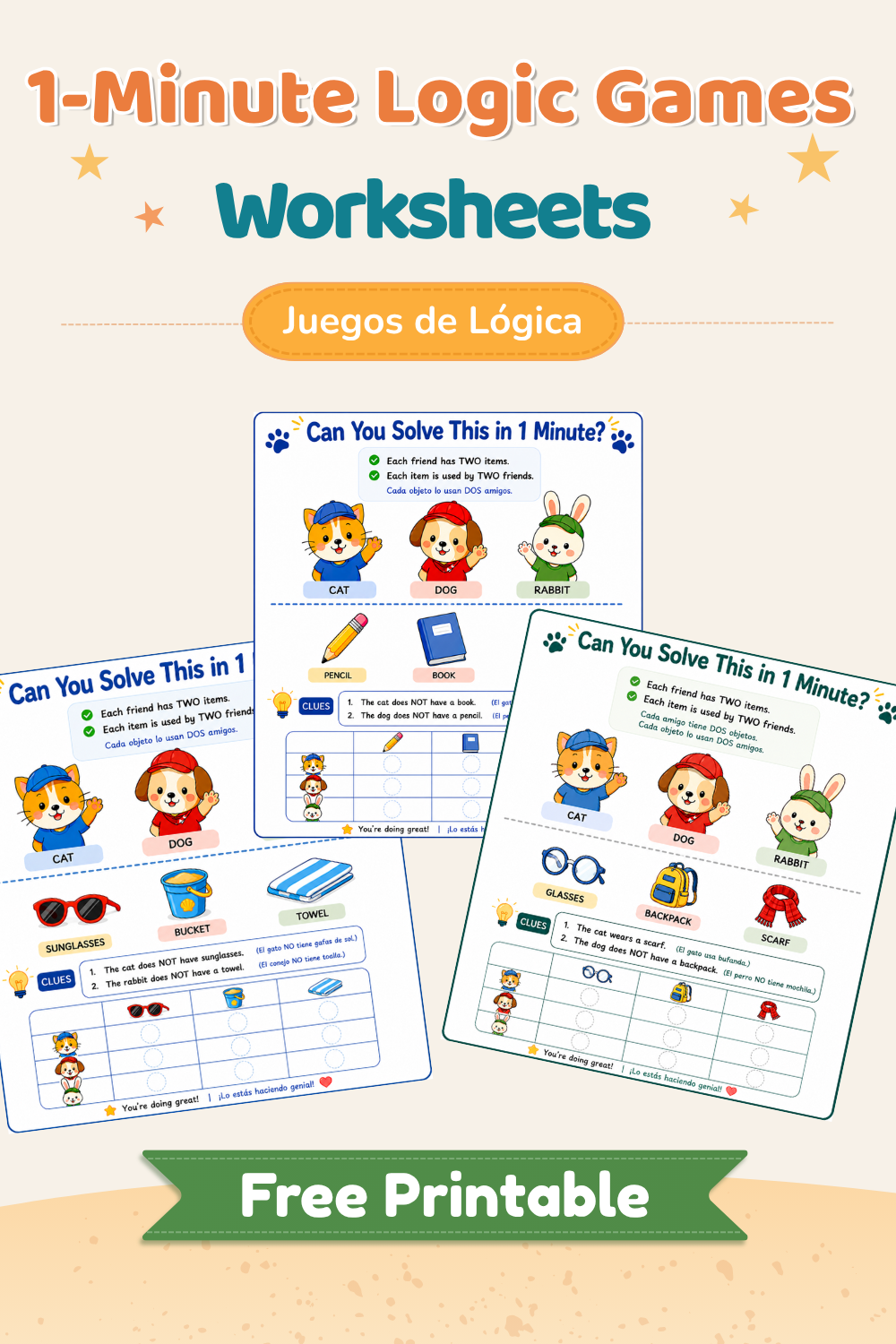
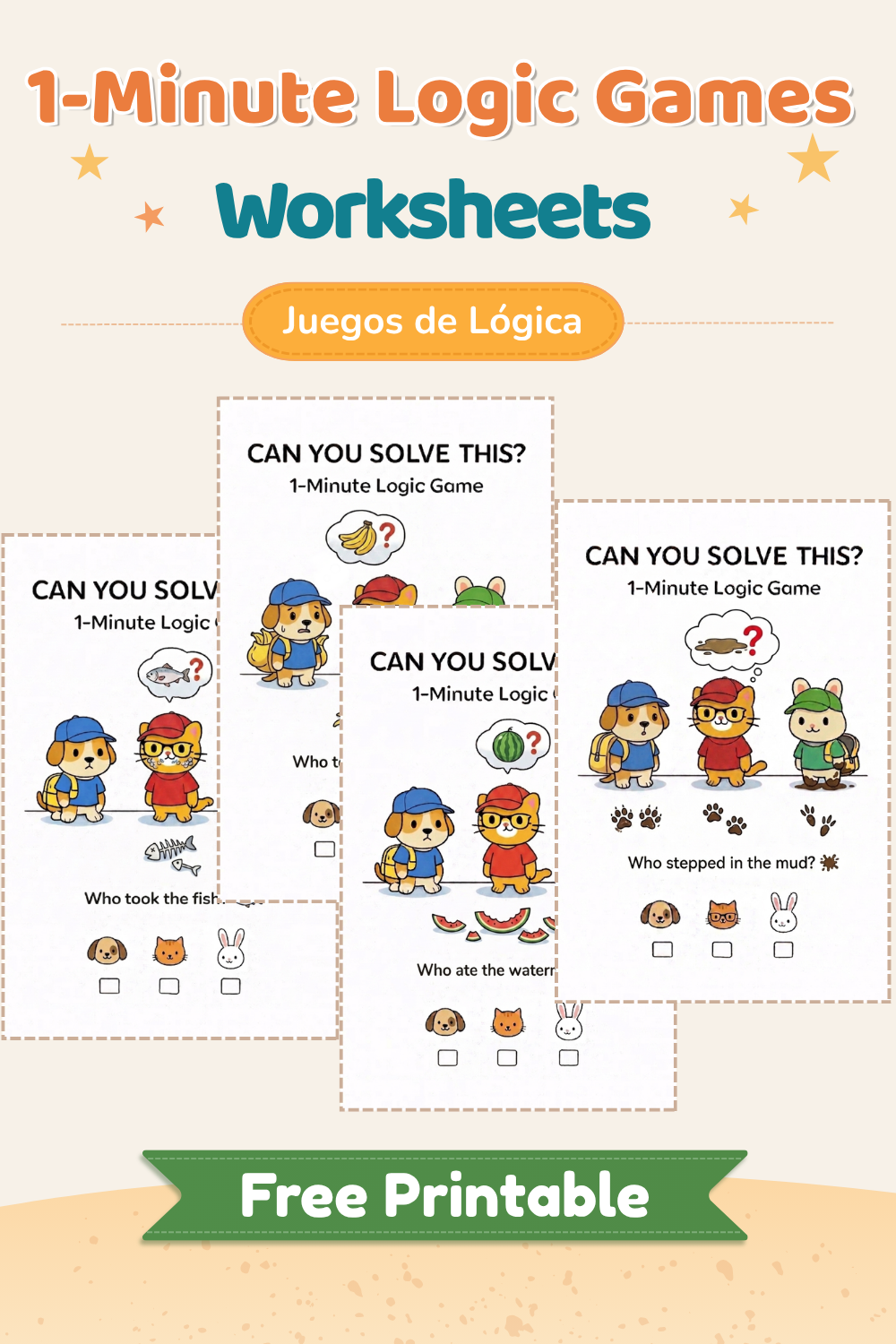
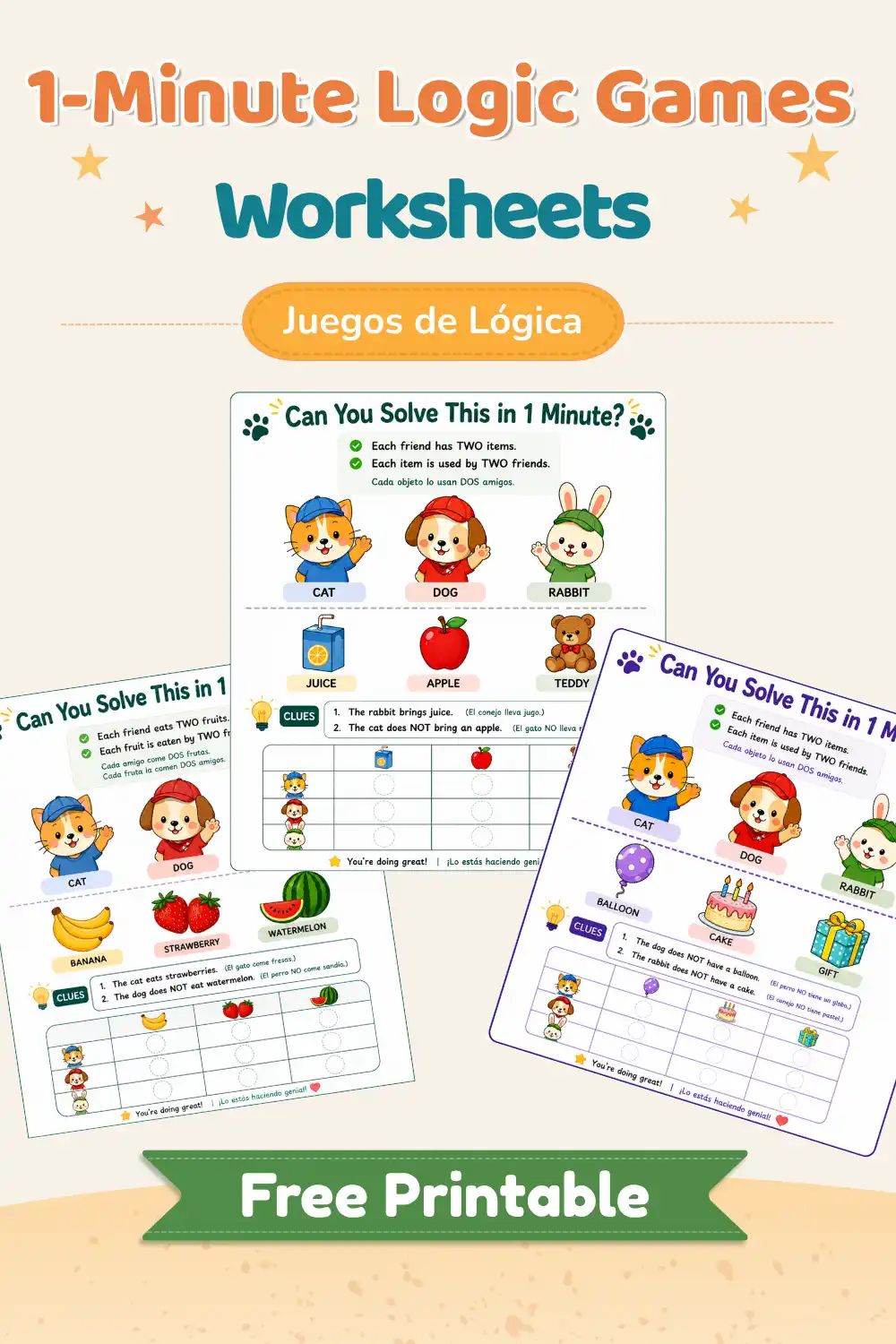
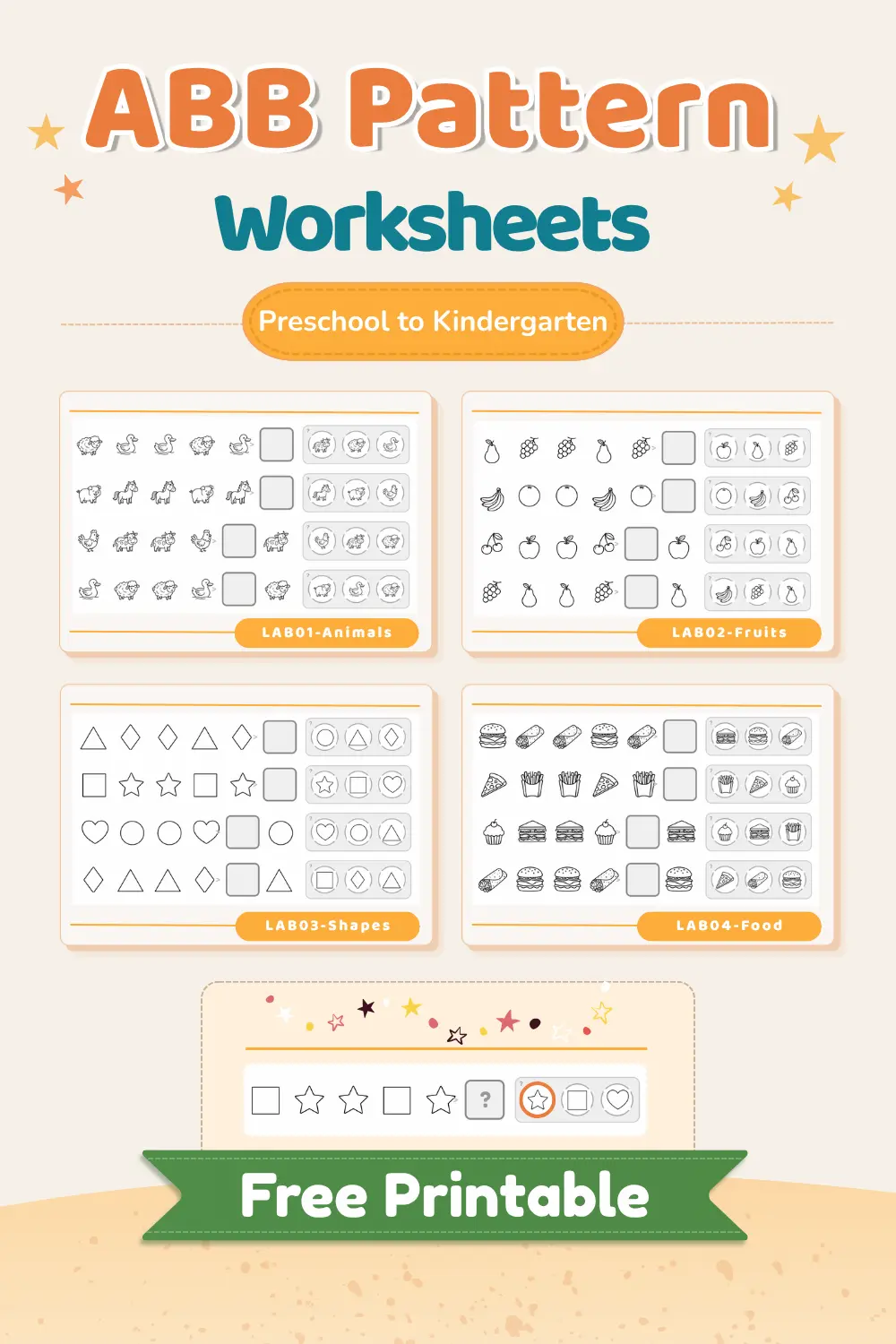
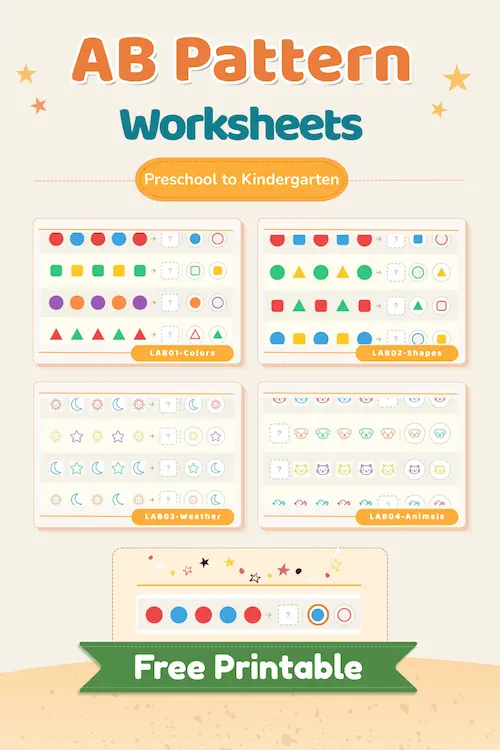
Pattern activities are another strong option. AB patterns (red–blue–red–blue), ABB patterns, missing-piece puzzles — these start simple enough to produce early wins but have enough complexity to stretch a child’s thinking gradually.
The key is choosing the right level. A child who gives up easily needs to experience success more often than they experience frustration, at least in the beginning. That ratio shifts naturally as confidence builds.
👉 [Pattern Worksheets — free printables organized by level]
Hands-on building toys — magnetic tiles, simple wooden blocks, LEGO Duplo — are particularly good for children who quit because they learn better through their hands than through paper. The immediate physical feedback (it stands, it falls, I can try again in five seconds) removes a lot of the threat. There’s no permanent record of the failure. You just pick up the pieces and go again.
What makes these work isn’t just the toy itself — it’s the structure around it. A small, specific challenge (“can you build something with exactly 6 pieces?”) keeps the task bounded and achievable, which is exactly what a child who gives up easily needs.
👉 [Best Toys for Building Concentration in Children Ages 3 to 6]
A Note on Timing
One thing that doesn’t get mentioned enough: children who give up easily often do so partly because the activity was introduced at the wrong moment in their day.
A preschooler who is hungry, overstimulated, or running on a disrupted nap is working with significantly fewer cognitive resources than usual. The same puzzle that might take ten focused minutes at 10am can feel completely overwhelming at 5pm. This isn’t an excuse — it’s useful information. Timing activities for when your child is genuinely available (fed, rested, not freshly off a screen) can make a real difference in how they respond to challenge.
The Longer Game
Building persistence in a child who gives up easily isn’t a project you finish in a week. It’s more like gradually adjusting the conditions until trying feels normal, and sticking with something hard feels possible rather than humiliating.
The children who get there aren’t the ones who were pushed harder or corrected more often. They’re the ones who had enough experiences of I tried something hard, and I made it through that the next hard thing felt less threatening.
That’s the goal. Not toughening them up. Just making the territory of “hard things” feel a little more familiar every time.
You’re building that with them, one small activity at a time.
LogicToy Lab | Bilingual early thinking activities for Spanish-speaking families in the United States. Free resources for children ages 3 to 6. No sign-up required.