
Every afternoon, I walk into that bright, busy daycare room, and I spot my son. He’s doing fine. He’s playing with the toy kitchen, smiling at a friend, maybe patting the teacher’s leg. Then he looks up and sees me. And the wailing starts. Full-on, face-crumpled, arms-flailing crying.
I can feel the other moms glance over, maybe thinking the same thing I used to think: Does he not want to see me? Did something go wrong? Is he mad that I left him all day? My husband gets a happy squeal and a scramble into his arms. I get tears. And there’s a little part of me, every single time, that feels a quiet, sharp sting of rejection.
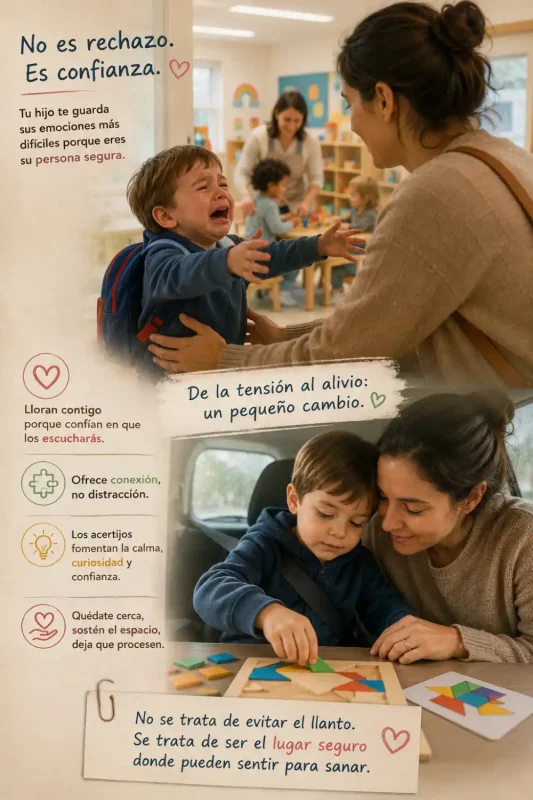
It took me a long time to realize this: the crying is not because he’s sad I showed up. It’s because I’m his safe person, the one he has saved the hardest emotions for all day. Some preschoolers don’t cry because they are hurt. They cry because they finally feel safe enough to show how they really feel.
Why They Save the Meltdown for You
When your baby is at daycare, they are holding it together all day long. They are navigating transitions, listening to new adults, learning to share, sitting in circle time, following rules. They are doing emotional work every minute. And because their brain is still small, they are storing all that tension.
The moment he saw me, another huge wave of emotions could finally, crash downstream. He was communicating trust, not disappointment. He cried because I was the one who would actually listen.
If your mommy disappears crying feels personal, you’re not alone. That crying is often not about rejecting you, it’s about processing everything that could not happen while you were gone.
Why It Can Be So Hard to See
When my son only cries for me at pickup, I used to feel like I had failed. I would interrogate my husband: maybe he just likes his daddy better? Maybe I should stay home? But the truth is, the child who feels more secure with one parent tends to reserve their most intense feelings for that parent. Because the connection is stronger, the release is louder.
So when he wails at the sight of me, I remind myself: he isn’t punishing me. He is paying me a compliment. He trusts me with his messy, unpolished emotions. The dad gets the show. I get the real story.
Boredom also plays a role sometimes. Daycare is stimulating but passive for some kids. When the structure suddenly ends, the emotions that have been building all day come flooding out. It feels like they are refusing to leave (no, no, no!), but in reality, they can’t control what happens next.
What You Can Actually Do, When Exhaustion Hits
Friday afternoons are the worst. He’s tired, I’m tired, the car seat feels like a cage. When tears start at pickup, I used to rush home and hand him the iPad, hoping for quiet. But honestly, the screen made the crash worse. He would come unfocused and cranky an hour later.
Instead, what worked for us is low-pressure interaction. I keep a little printable logic puzzle set in the car for those rainy-day, gotta-keep-it-together moments. It feels like a quiet thinking game, not a worksheet. Worksheets made my son feel watched. Puzzles made him feel curious.
I set it on the kitchen table while I started dinner. He ignored it for three afternoons. Then one day, he sat down, stuck out his tongue, and solved one. When he found the right spot, he whispered, I did it. That moment, when the crying stopped and the thinking started, I saw what he really needed: not a distraction, but a problem he could own.
How to Recognize the Difference
The same emotional resistance that comes out as crying at daycare sometimes comes out as total resistance at home. My preschooler is smart and energetic, exactly the kind of strong-willed kid who will flatly say No the moment you unfold a worksheet. He does not want to feel evaluated. He does not want to be watched and tested.
So I tried to leave space for that. When the I hate learning routine starts, I ask a simple question: Can you find the piece that has three sides? Instead of a worksheet, it becomes a puzzle. Instead of being test, it feels like a game. Some kids say no to learning because they are really saying no to pressure.
Children who constantly ask for iPads are often not lazy or bored. They are craving engagement. Passive YouTube videos give them dopamine without connection. But a puzzle that clicks into place, or a matching game that requires one tiny observation, puts the decision-making back in their hands.
From Tension to Relief: A Small Shift
There are days when nothing works. He is melting in the doorway. The puzzle tub gets dumped on the floor before breakfast. I still have days where I just give up, turn on the TV, and hope for the best. That is normal too.
But what I have learned, standing in that daycare doorway with a crying toddler in my arms, is that some resistance is not a problem to fix. It is a message to hear, one that says: I trusted my day would go okay, and now I need to trust you to carry this hard heavy emotion.
Today, when I load him into the car and watch the tears run into his car seat straps, I try to sit still next to him. Without jumping to silence his distress. And slowly, very slowly, the angry cries soften. Into a quiet hiccup. And then into a sigh.
And sometimes he falls asleep against the padding, finally calm because he landed in the right arms.
Sometimes the best thing we can do is stand still, hold the space, and let them cry in peace.